Romans Verses: 25 Powerful Scriptures for Faith and Hope
Romans verses contain some of the most theologically rich and personally transformative passages in all of Scripture. The book of Romans is not merely a doctrinal treatise — it is a letter written to real people facing real struggles, written by a man who understood what it meant to suffer, doubt, press forward, and trust God in the middle of uncertainty.
Whether you are searching for Romans verses about faith, hope, salvation, suffering, or God’s love — this guide gives you 25 of the most powerful passages from Romans, organized by theme, with deep explanations of what each verse means and how to apply it to your actual life today.
Romans 8:28 may be the most quoted verse in the book — “And we know that in all things God works for the good of those who love him.” But Romans is filled with verses that carry just as much weight, many of which most people have never stopped long enough to let fully land.
Romans Verses About Faith
Faith is one of the central themes running through the entire book of Romans. Paul’s foundational argument — that righteousness comes through faith, not works — shapes every chapter. These Romans verses about faith are not just theological statements. They are invitations to trust God in ways that go beyond what circumstances support.
1. Romans 1:17 — “For in the gospel the righteousness of God is revealed — a righteousness that is by faith from first to last, just as it is written: ‘The righteous will live by faith.'”
This is the verse that changed Martin Luther’s life and sparked the Protestant Reformation. “The righteous will live by faith” — not begin by faith and then maintain by performance. The entire Christian life, from first to last, is by faith. These Romans verses about faith establish that trust in God is not the starting point of the Christian life — it is the whole thing.
2. Romans 3:22 — “This righteousness is given through faith in Jesus Christ to all who believe.”
The word “all” in this verse is doing significant theological work. Not to the most devout. Not to those who have earned it. To all who believe. Every Romans verse about faith points back to this foundation: righteousness is received, not achieved.
3. Romans 4:20-21 — “Yet he did not waver through unbelief regarding the promise of God, but was strengthened in his faith and gave glory to God, being fully persuaded that God had power to do what he had promised.”
Paul uses Abraham as the model of faith precisely because Abraham’s situation was impossible by human calculation. He was old. Sarah was barren. The promise made no natural sense. And yet he was “fully persuaded.” These Romans verses about faith challenge the reader: is your faith based on what makes sense, or on who God is?
4. Romans 5:1 — “Therefore, since we have been justified through faith, we have peace with God through our Lord Jesus Christ.”
Peace with God is the fruit of faith. Not peace of mind as a feeling — but an objective reality: the hostility between the sinful human and the holy God has been ended through Christ. These Romans verses about faith remind us that justification is not just a legal declaration — it has relational consequences. We are at peace with God.
5. Romans 10:17 — “Consequently, faith comes from hearing the message, and the message is heard through the word about Christ.”
This is one of the most practical Romans verses about faith because it tells you how faith grows: through the Word. Not through trying harder to believe. Not through manufacturing feelings. Through hearing, reading, and meditating on what God has said about Christ. Faith is a response to a message — and the message has already been given.
Romans Verses About Hope
Hope in Romans is not wishful thinking — it is a confident expectation based on the character of God and the promises He has made. These Romans verses about hope speak into every season of waiting, suffering, and uncertainty.
6. Romans 5:3-5 — “Not only so, but we also glory in our sufferings, because we know that suffering produces perseverance; perseverance, character; and character, hope. And hope does not put us to shame, because God’s love has been poured out into our hearts through the Holy Spirit, who has been given to us.”
This is one of the most counterintuitive Romans verses in the entire book. Suffering produces hope — not because suffering is good, but because of what it produces in the person who endures it with faith. The chain is deliberate: suffering → perseverance → character → hope. These Romans verses about hope tell us that the seasons we most want to escape are often the ones most actively building what we need most.
7. Romans 8:24-25 — “For in this hope we were saved. But hope that is seen is no hope at all. Who hopes for what they already have? But if we hope for what we do not yet have, we wait for it patiently.”
Hope by definition requires an unseen future. These Romans verses about hope reframe the experience of waiting — not as a failure of faith, but as the very definition of it. We wait not because God is slow, but because what we are waiting for has not yet arrived.
8. Romans 12:12 — “Be joyful in hope, patient in affliction, faithful in prayer.”
Three commands linked together as a single posture of life. Joyful in hope — not joyful because everything is resolved, but joyful because of what is coming. Patient in affliction — not passive, but enduring with faith. Faithful in prayer — the practice that connects the believer to the source of both hope and patience. These Romans verses about hope are not abstract — they are daily instructions.
9. Romans 15:4 — “For everything that was written in the past was written to teach us, so that through the endurance taught in the Scriptures and the encouragement they provide we might have hope.”
This verse tells us why we have the Old Testament. Not primarily as history or law — but as a source of hope. The stories of God’s faithfulness in the past are given to us so that we might find hope for the present. Every Romans verse about hope is an invitation to read Scripture as a hope-producing document.
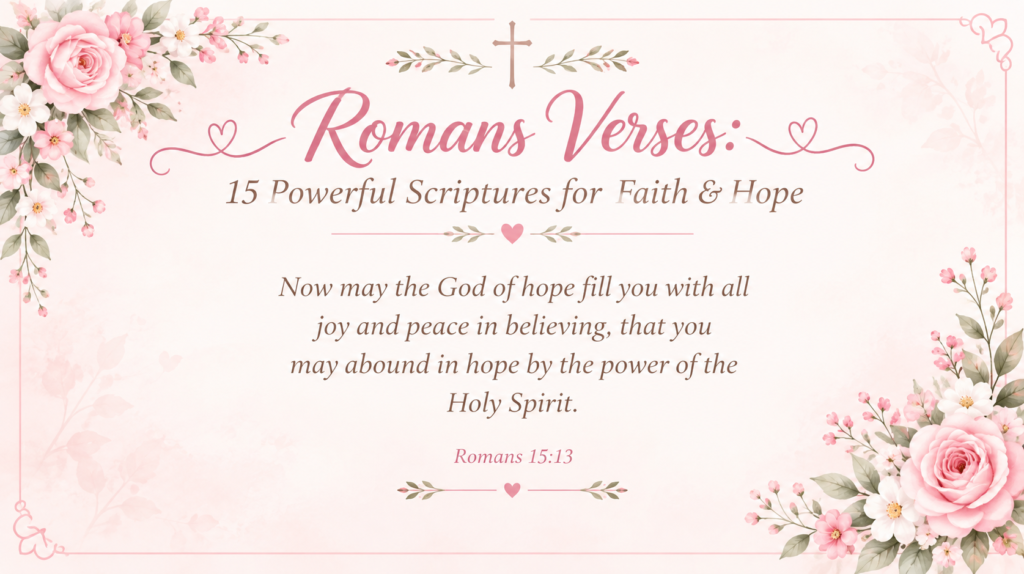
10. Romans 15:13 — “May the God of hope fill you with all joy and peace as you trust in him, so that you may overflow with hope by the power of the Holy Spirit.”
This is perhaps the most beloved Romans verse about hope in the entire book. God is called “the God of hope” — not merely the God who promises hope, but the One from whom hope originates. Notice the means: “as you trust in him.” And notice the result: not just having hope but overflowing with it. These Romans verses about hope set a high bar — not survival but abundance.
Romans Verses About God’s Love
Nothing in Romans is more personal than what Paul writes about the love of God. These Romans verses about God’s love are not gentle encouragements — they are declarations that challenge every fear, every doubt, and every voice that says God’s love is conditional.
11. Romans 5:8 — “But God demonstrates his own love for us in this: while we were still sinners, Christ died for us.”
The timing is everything in this verse. Not after we cleaned up. Not after we believed. While we were still sinners. This is one of the most staggering Romans verses in the entire book because it removes every condition from God’s love. His love was demonstrated at our worst, not our best.
12. Romans 8:38-39 — “For I am convinced that neither death nor life, neither angels nor demons, neither the present nor the future, nor any powers, neither height nor depth, nor anything else in all creation, will be able to separate us from the love of God that is in Christ Jesus our Lord.”
Paul does not say nothing will separate us. He lists every category he can imagine — death, life, the supernatural, time, space, power — and declares none of them sufficient to break the bond. These Romans verses about God’s love are a declaration of permanence. The love is not conditional on your performance, your consistency, or your emotional state.
13. Romans 8:31-32 — “What, then, shall we say in response to these things? If God is for us, who can be against us? He who did not spare his own Son, but gave him up for us all — how will he not also, along with him, graciously give us all things?”
The logic here is compelling: if God gave the greatest gift — His Son — why would He withhold lesser gifts? These Romans verses about God’s love use the cross as the proof of God’s generosity. Everything else He gives flows from that foundational gift.
Romans Verses About Salvation and Grace
Paul’s letter to the Romans is fundamentally about how sinful people can be made right with a holy God. These Romans verses about salvation establish the most important truth in all of Scripture.
14. Romans 3:23-24 — “For all have sinned and fall short of the glory of God, and all are justified freely by his grace through the redemption that came by Christ Jesus.”
“All have sinned” removes every exception. “Justified freely by his grace” removes every human contribution. These Romans verses about salvation are among the most quoted in Scripture because they capture the entire gospel in two sentences.
15. Romans 6:23 — “For the wages of sin is death, but the gift of God is eternal life in Christ Jesus our Lord.”
The contrast is deliberate: wages versus gift. What sin earns and what God freely gives are placed side by side. These Romans verses about salvation make clear that eternal life is not achieved — it is received. The gift must simply be accepted.
16. Romans 10:9 — “If you declare with your mouth, ‘Jesus is Lord,’ and believe in your heart that God raised him from the dead, you will be saved.”
This is one of the clearest Romans verses about salvation in the entire book. Two elements: confession with the mouth and belief in the heart. Both matter. Both are required. And the promise is absolute: you will be saved.
17. Romans 8:1 — “Therefore, there is now no condemnation for those who are in Christ Jesus.”
“Now” is the key word. Not when you have improved enough. Not when the guilt finally lifts. Now — at this moment, in your current state, if you are in Christ — there is no condemnation. These Romans verses about salvation are not future promises. They are present realities.
Romans Verses About Suffering and Perseverance
Romans does not avoid the reality of suffering. It addresses it directly and honestly — and offers something far more valuable than easy comfort. These Romans verses about suffering speak to the person in the middle of the hardest season of their life.
18. Romans 8:18 — “I consider that our present sufferings are not worth comparing with the glory that will be revealed in us.”
Paul is not minimizing present suffering — he lived through extraordinary hardship. He is offering a perspective that changes the proportion: present pain placed against eternal glory becomes, in that comparison, something that does not outweigh what is coming. These Romans verses about suffering are not dismissive — they are profoundly hopeful.
19. Romans 8:26 — “In the same way, the Spirit helps us in our weakness. We do not know what we ought to pray for, but the Spirit himself intercedes for us through wordless groans.”
This is one of the most comforting Romans verses in the entire book for the person who has run out of words. When you do not know what to pray — when you cannot find the language for what you are feeling — the Spirit prays for you. These Romans verses about suffering tell us that even wordless grief reaches God.
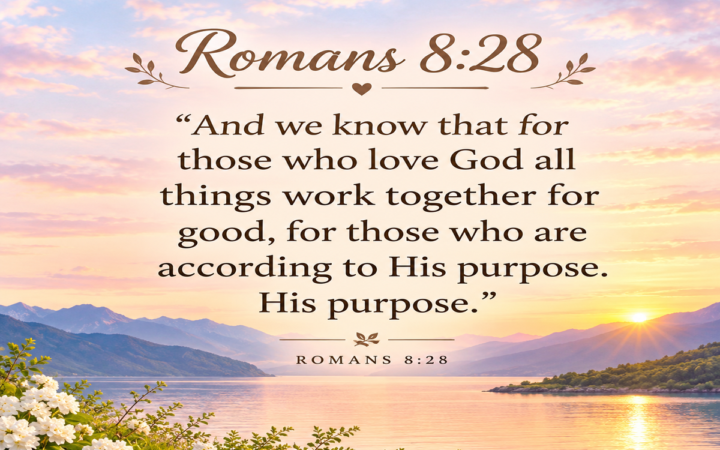
20. Romans 8:28 — “And we know that in all things God works for the good of those who love him, who have been called according to his purpose.”
Perhaps the most quoted Romans verse of all — but note what it does not say. It does not say all things are good. It says God works all things for good. The difficulty is real. The working is also real. These Romans verses about suffering do not promise an easy path — they promise a purposeful One.
Romans Verses About Transformation and Daily Living
Paul’s letter does not end with theology — it moves into practice. These Romans verses about daily Christian living are some of the most specific and actionable in all of his letters.
21. Romans 12:1-2 — “Therefore, I urge you, brothers and sisters, in view of God’s mercy, to offer your bodies as a living sacrifice, holy and pleasing to God — this is your true and proper worship. Do not conform to the pattern of this world, but be transformed by the renewing of your mind.”
The “therefore” connects everything that came before — all the theology of Romans 1-11 — to this practical call. Worship is not a Sunday activity. It is the daily offering of your entire self to God. These Romans verses about transformation name what renewal actually looks like: a changed mind that produces a changed life.
22. Romans 12:9-10 — “Love must be sincere. Hate what is evil; cling to what is good. Be devoted to one another in love. Honor one another above yourselves.”
These Romans verses about daily living are some of the most practically challenging in the book. Sincere love — not performed, not conditional. Devotion to one another. Honoring others above yourself. This is the community life Paul envisioned for believers.
23. Romans 12:21 — “Do not be overcome by evil, but overcome evil with good.”
One of the shortest and most powerful Romans verses in the entire book. The temptation when wronged is to repay in kind. Paul reverses this completely: the way to overcome evil is not through resistance alone but through the active force of good. These Romans verses about transformation challenge passive Christianity.
24. Romans 13:14 — “Rather, clothe yourselves with the Lord Jesus Christ, and do not think about how to gratify the desires of the flesh.”
The image of clothing is intentional — it is something you put on deliberately each morning. These Romans verses about daily living present the Christian life not as a passive experience but as a daily act of intentional choice.
25. Romans 8:37 — “No, in all these things we are more than conquerors through him who loved us.”
“More than conquerors” — not barely surviving, not just enduring, but abundantly overcoming. And the source is not human strength: “through him who loved us.” These Romans verses about transformation close with the reminder that the victory is His, offered to those who remain in relationship with the One who already won it.
Bible Verses That Deepen Your Understanding of Romans
Romans does not exist in isolation — it connects to the whole of Scripture. These passages from other books illuminate the same themes found throughout Romans verses.
Habakkuk 2:4 — “The righteous person will live by his faithfulness.” Paul quotes this verse directly in Romans 1:17, connecting the New Testament gospel to the ancient Hebrew prophets. Understanding Romans verses about faith means understanding that Paul was not inventing something new — he was revealing what had always been true.
Isaiah 53:5 — “But he was pierced for our transgressions, he was crushed for our iniquities.” The substitutionary atonement that Romans explains theologically is described prophetically here. Isaiah wrote this 700 years before the crucifixion.
Psalm 32:1-2 — “Blessed is the one whose transgressions are forgiven, whose sins are covered.” Paul quotes this passage in Romans 4 as evidence that justification by faith existed long before Christ — it was always God’s method of making sinners righteous.
These passages from other books illuminate the same themes found throughout the book of Romans and help readers understand Paul’s letter in its full biblical context.
How to Use Romans Verses in Daily Life
Romans verses are not only for theological study — they are living words meant to be prayed, declared, and applied. Here is how to make them part of your actual daily life.
Memorize one verse per week. Choose one Romans verse from this collection and commit it to memory. Romans 8:28, Romans 15:13, and Romans 5:8 are powerful starting points. Memorized Scripture becomes immediately available in moments of crisis when you most need it.
Pray Romans verses back to God. Take a Romans verse and turn it into a prayer. Romans 15:13 becomes: “God of hope, fill me with all joy and peace as I trust in You. Let me overflow with hope by the power of the Holy Spirit.” Praying Scripture aligns your prayer with God’s declared will.
Use Romans verses as morning anchors. Choose a different Romans verse each morning and let it frame the day. Romans 8:1 — “There is no condemnation” — is a powerful way to begin a day when guilt or shame is present. Romans 12:1 — “offer your bodies as a living sacrifice” — reframes the entire day as an act of worship.
Share Romans verses with people who are struggling. Romans 8:26 — the Spirit intercedes for us through wordless groans — is a profound comfort for someone who has run out of words to pray. Romans 8:38-39 — nothing can separate us from God’s love — speaks directly to the person afraid that their failure has ended their relationship with God.
Frequently Asked Questions About Romans Verses
What are the most important Romans verses? Romans 3:23-24, Romans 5:8, Romans 8:1, Romans 8:28, Romans 8:38-39, and Romans 15:13 are among the most significant passages in the entire book. Each one addresses a foundational truth about sin, grace, salvation, and the love of God.
What is the main message of the book of Romans? Romans establishes that all people are sinners who cannot make themselves righteous before God. Righteousness comes through faith in Jesus Christ alone, available to everyone who believes. The book then explains the implications of this salvation: a transformed life, a renewed mind, and a hope that does not disappoint.
What does Romans 8:28 mean? It means that God is actively working in every circumstance — including painful and confusing ones — toward a good outcome for those who love Him. It does not say all things are good. It says God works all things for good. The suffering is real; the purposeful working is also real.
What passages in Romans are best for anxiety? Romans 8:26 — the Spirit intercedes through wordless groans — speaks to the person too anxious to find words. Romans 8:38-39 — nothing can separate us from God’s love — addresses the fear that God has withdrawn. Romans 5:1 — we have peace with God — reminds the anxious believer that their standing before God is secure.
What does Romans 12:2 mean? It calls believers to stop being shaped by surrounding culture and to be transformed instead by the renewing of their minds. This transformation happens through Scripture, prayer, and the ongoing work of the Holy Spirit — not a one-time event but a continuous process.
Which passages in Romans talk about God’s love? Romans 5:8 — God loved us while we were still sinners. Romans 8:31-32 — God did not spare His own Son for us. Romans 8:38-39 — nothing in all creation can separate us from His love. These three passages together form the most complete picture of God’s love in the New Testament.
How should I study the book of Romans? Read Romans in full first to understand Paul’s argument. Then study individual passages in context. Use a commentary for historical background. Pray each passage before and after reading. Apply what you find to a specific current situation in your life.
What is the most comforting passage in Romans? Romans 8:38-39 — “nothing will be able to separate us from the love of God” — is the most comprehensive comfort. Romans 8:26 — “the Spirit himself intercedes for us” — is the most intimate. Romans 8:1 — “there is now no condemnation” — is the most immediate relief for those carrying guilt.
Final Thought: Romans Verses That Can Change Everything
The book of Romans was written to a community of believers in one of the most powerful and dangerous cities in the ancient world. They faced pressure from the culture, division within their own community, and the daily challenge of living faith in an environment that did not share it.
Two thousand years later, the Romans verses Paul wrote for them speak with the same authority and the same relevance into the lives of people facing entirely different circumstances with the same essential needs: to know they are loved, to understand what God has done, to find hope that does not depend on circumstances, and to live the transformation that the gospel makes possible.
Romans 15:13 is Paul’s prayer for every person who has ever read his letter: “May the God of hope fill you with all joy and peace as you trust in him, so that you may overflow with hope by the power of the Holy Spirit.”
That is the Romans verse that summarizes what the entire book is offering — not just information about God, but an encounter with the God of hope Himself, who fills, who gives joy and peace, and who causes His people to overflow rather than merely survive.
To read the complete book of Romans in full — one of the most transformative documents in all of human history — visit Romans on Bible Gateway and let every chapter speak to wherever you are today.
LOOKING FOR SOME MORE ENGAGING CONTENT: