Romans 8:28 Meaning: 7 Powerful Truths for Difficult Times
The Romans 8:28 meaning is not that everything that happens is good. It is the Christian promise that, for those who love God and are called according to His purpose, even painful circumstances cannot ultimately defeat God’s purpose for their good.
That distinction changes everything.
Romans 8:28 is often quoted after disappointment, loss, illness, failure, or an unexpected change. Yet Paul did not write these words as a shallow promise that every difficult situation will quickly produce a happy ending.
The surrounding passage talks openly about suffering, weakness, waiting, groaning, prayer, hope, and future glory.
To understand the Romans 8:28 meaning, therefore, we need to read the promise beside Romans 8:29. The “good” God is accomplishing includes shaping believers into the likeness of His Son.
The verse offers something deeper than “everything will work out exactly as you want.”
It offers confidence that suffering does not place God’s people beyond His purpose.
What Is the Romans 8:28 Meaning?
The Romans 8:28 meaning can be summarized simply:
God can work through every circumstance in the lives of those who love Him to accomplish His good purpose, even when they cannot yet understand what He is doing.
The King James Version reads:
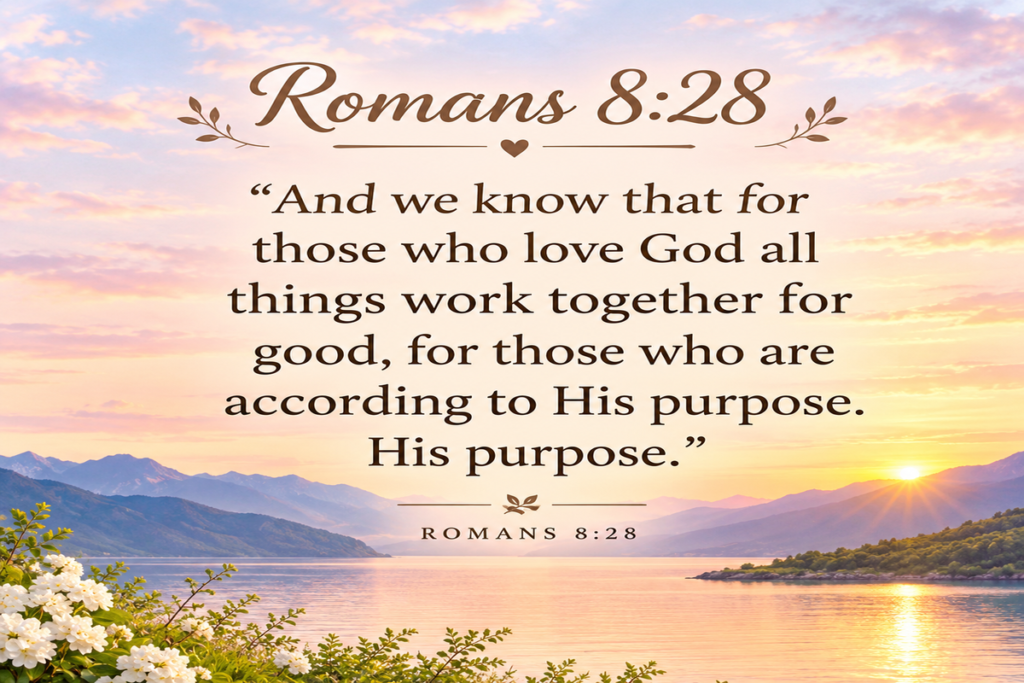
“And we know that all things work together for good to them that love God, to them who are the called according to his purpose.”
You can read Romans 8:28 in context on Bible Gateway.
Notice what the verse does not say.
It does not say all things are good.
It does not say Christians will understand everything that happens.
It does not promise immediate happiness.
It does not promise wealth, health, success, or freedom from suffering.
And it does not tell grieving people that their pain is imaginary.
The Romans 8:28 meaning is stronger than those interpretations because its hope depends upon God’s purpose rather than favorable circumstances.
7 Powerful Truths About Romans 8:28
Understanding the Romans 8:28 meaning becomes easier when the verse is broken into its central ideas.
1. “We Know” Expresses Confidence in God
The Romans 8:28 meaning begins with two important words:
“We know.”
Paul does not begin with “we feel.”
Feelings change quickly during suffering.
One morning you may feel hopeful. That evening you may feel discouraged.
Circumstances change too.
Paul grounds Christian confidence somewhere deeper.
The certainty of Romans 8 does not depend on understanding every event. It rests on confidence in God’s character and purpose.
That matters when life makes no sense.
Faith does not always mean saying:
“I understand why this happened.”
Sometimes faith says:
“I don’t understand this, but I will continue trusting God.”
That is a much more honest application of the verse.
2. “All Things” Includes Painful Things
One of the most misunderstood parts of the Romans 8:28 meaning is the phrase “all things.”
Paul has already been discussing suffering in Romans 8.
Creation groans.
Believers groan.
People wait.
Human weakness is real.
Sometimes believers do not even know what they should pray for.
Then comes Romans 8:28.
This context prevents us from interpreting “all things” as only pleasant experiences.
It can include disappointment.
Loss.
Waiting.
Failure.
Unanswered questions.
Unexpected changes.
Seasons when prayer seems difficult.
The Romans 8:28 meaning does not require Christians to call those experiences good.
Instead, it says they cannot prevent God from accomplishing His purpose.
That is a very different claim.
3. “Work Together” Points Toward a Larger Purpose
Another important part of the Romans 8:28 meaning is that individual circumstances should not always be judged in isolation.
One painful event may look completely meaningless from where we stand.
We see one moment.
One disappointment.
One closed door.
One season.
God’s purposes extend beyond what we can presently see.
This does not mean Christians should invent explanations for tragedy.
We should be careful about saying:
“God did this because…”
when Scripture has not told us why a specific event happened.
Romans 8:28 gives assurance without giving us permission to pretend we know every hidden reason.
The Romans 8:28 meaning allows mystery to remain.
We can trust without pretending to understand.
4. “For Good” Does Not Simply Mean Getting What We Want
Perhaps the most important key to the Romans 8:28 meaning is the word good.
What is good?
A promotion?
More money?
Recovery?
A restored relationship?
A successful plan?
Those things may certainly be good gifts.
But the next verse takes the discussion deeper.
Romans 8:29 speaks about believers being conformed to the image of God’s Son.
This means the Romans 8:28 meaning cannot be reduced to:
“Something better will always happen soon.”
Sometimes circumstances remain difficult.
Sometimes a loss is not reversed.
Sometimes the door stays closed.
Sometimes healing does not arrive in the way people hoped.
Biblical good is bigger than immediate comfort.
God’s purpose includes making His people more like Christ and ultimately bringing His saving purpose to completion.
5. The Promise Is Given to Those Who Love God
The Romans 8:28 meaning also has an important qualification.
Paul speaks about:
“them that love God.”
The verse is not presented as a generic motivational law claiming every event automatically produces a personally desirable outcome for everyone.
It belongs within Paul’s discussion of believers and God’s saving work.
That makes Romans 8:28 distinctly Christian.
Its hope is not:
“The universe will eventually give me what I want.”
Its hope is:
God remains faithful to His people and His purpose.
Understanding this keeps the verse centered on God rather than turning it into positive-thinking advice.
6. “Called According to His Purpose” Shifts the Focus to God
The Romans 8:28 meaning becomes even clearer in the final words:
“called according to his purpose.”
Our plans matter to us.
We pray about careers.
Relationships.
Families.
Health.
Finances.
Dreams.
But Romans 8:28 ultimately points toward God’s purpose, not merely ours.
That can be challenging.
We often want God to support the story we have already written.
Biblical faith gradually teaches us to ask a different question:
“Lord, how can my life serve Your purpose?”
That does not mean desires are meaningless.
It means Christian hope rests on something larger than receiving everything we request.
7. Romans 8:29 Helps Define the “Good”
Never stop reading at verse 28.
This may be the most important rule for understanding the Romans 8:28 meaning.
Romans 8:29 immediately continues the thought and speaks of being conformed to the image of God’s Son.
That gives the word “good” theological depth.
God’s good purpose involves Christlikeness.
Character.
Holiness.
Redemption.
Ultimately, glory.
This does not mean every tragedy exists merely to teach someone a lesson.
That can be a cruel thing to say to a grieving person.
It means suffering cannot finally prevent God from completing His work in His people.
The Romans 8:28 meaning therefore looks beyond temporary circumstances toward God’s larger redemptive purpose.
Romans 8:28 Meaning in Context
Context protects the Romans 8:28 meaning from becoming a motivational slogan.
Start around Romans 8:18.
Paul talks about present suffering and future glory.
Creation is described as groaning.
Believers also groan as they wait.
Hope involves waiting patiently for what is not yet seen.
Then Romans 8:26 introduces another deeply comforting truth: human weakness can become so great that believers do not know what to pray.
The Spirit helps in that weakness.
Only then do we arrive at verse 28.
This sequence matters:
Suffering → Groaning → Waiting → Weakness → Prayer → God’s Purpose → Hope
Romans 8:28 is not spoken from outside suffering.
It is spoken directly into it.
That is why the Romans 8:28 meaning can comfort someone whose circumstances have not improved.
What Does “All Things Work Together for Good” Mean?
This phrase sits at the heart of the Romans 8:28 meaning.
Imagine looking at the back of a tapestry.
Threads cross in different directions.
Some appear disconnected.
Some seem unnecessary.
From behind, the design can be difficult to understand.
Turn it over and the threads belong to something larger.
This illustration has limits, but it helps explain the idea.
Christians often experience life from the unfinished side.
We see individual events without seeing the complete story.
Romans 8:28 does not promise that every thread will become understandable during this life.
It promises that the story is not outside God’s purpose.
That distinction protects Christian hope from becoming simplistic.
Does Romans 8:28 Mean Everything Happens for a Reason?
This is one of the biggest questions surrounding the Romans 8:28 meaning.
The phrase “everything happens for a reason” does not appear in Romans 8:28.
The verse makes a more specific claim.
It says that all things work together for good for those who love God and are called according to His purpose.
Those ideas are related, but they are not identical.
“Everything happens for a reason” can imply that we should be able to identify a neat explanation for every tragedy.
Romans 8:28 does not require that.
Sometimes Christians will never know why a particular event happened.
Faith can say:
“I do not know why this happened, but I trust that God has not abandoned His purpose.”
That captures the Romans 8:28 meaning more carefully.
Does Romans 8:28 Say Bad Things Are Good?
No.
This is a crucial distinction in the Romans 8:28 meaning.
The verse says all things work together for good.
It does not say all things are good.
Death hurts.
Betrayal hurts.
Injustice is wrong.
Illness is painful.
Sin is destructive.
Loss can change a family permanently.
Christian faith does not need to rename evil as good in order to trust God.
Romans 8:28 offers the stronger hope that evil and suffering do not possess unlimited power over God’s ultimate purposes.
That allows Christians to grieve honestly while still hoping deeply.
What Does “Good” Mean in Romans 8:28?
To understand the Romans 8:28 meaning, read verses 28 and 29 together.
The good includes being shaped toward the likeness of Christ.
This changes how we interpret God’s promise.
We often define good as:
“Life becomes easier.”
God’s purpose may involve something deeper:
Faith becomes stronger.
Character becomes more Christlike.
Dependence upon God deepens.
Love becomes less selfish.
Hope becomes anchored beyond circumstances.
Again, this does not mean every painful experience should be reduced to a spiritual lesson.
Some wounds remain deeply painful.
But the Romans 8:28 meaning assures believers that pain does not make God’s transforming purpose impossible.
Romans 8:28 Meaning During Suffering
The Romans 8:28 meaning becomes especially precious when life does not make sense.
Perhaps you prayed and the answer you wanted never came.
Perhaps a relationship ended.
Perhaps you lost someone.
Perhaps a plan collapsed.
Perhaps you are living through a season you would never have chosen.
Romans 8:28 does not ask you to smile and call everything wonderful.
It gives you permission to hold two truths together:
This hurts.
and
God has not abandoned me.
Those truths do not contradict each other.
Romans 8 itself contains suffering and hope in the same chapter.
Christian maturity does not require pretending pain is painless.
Romans 8:28 Meaning After Loss
People frequently turn to the Romans 8:28 meaning after bereavement.
This is also where the verse should be used most carefully.
Telling a grieving person “everything works for good” immediately after a death can sound like their loss is being minimized.
Sometimes presence is more helpful than explanation.
Sit with them.
Listen.
Let them cry.
Pray if they want prayer.
Romans 8:28 can eventually become an anchor of hope, but it should never become a weapon against grief.
The Romans 8:28 meaning does not tell mourners they should stop hurting.
It tells believers that even death cannot ultimately overthrow God’s redemptive purpose.
Romans 8:28 Meaning When Prayers Seem Unanswered
There is a beautiful connection between prayer and the Romans 8:28 meaning.
Just before verse 28, Paul describes believers who do not know what they should pray for.
That is remarkably honest.
Sometimes prayer is easy.
Sometimes all you have is:
“God, help me.”
Sometimes you cannot even form that sentence.
Romans 8 does not portray such weakness as spiritual failure.
The chapter speaks about the Spirit helping believers in their weakness.
Then comes the assurance of God’s purpose.
So when prayer feels unanswered, Romans 8:28 does not guarantee that God will eventually give the exact answer requested.
It assures believers that God’s work is larger than what they can currently see.
Romans 8:28 Meaning When a Door Closes
Another practical application of the Romans 8:28 meaning involves disappointment.
A job falls through.
An opportunity disappears.
A relationship changes.
A plan fails.
It is tempting to immediately declare:
“God closed this door because something better is coming.”
Maybe.
But Scripture does not promise that every closed door will soon be replaced by a more attractive one.
Sometimes the next season remains difficult.
A more careful response is:
“I do not know what comes next, but I trust God with what comes next.”
That statement reflects the Romans 8:28 meaning without pretending to know the future.
Romans 8:28 Meaning and God’s Purpose
God’s purpose is central to the Romans 8:28 meaning.
The verse ends there deliberately.
Christian life is not ultimately a project in getting God to accomplish our purpose.
It is learning to belong within His.
Romans 8:29–30 expands this larger saving purpose.
The emphasis moves from present circumstances toward what God is doing in His people.
This gives the verse stability.
Your circumstances may change.
God’s purpose does not depend upon every circumstance becoming comfortable.
That is why Romans 8:28 can remain meaningful on both wonderful and terrible days.
What Romans 8:28 Does Not Promise
A responsible explanation of the Romans 8:28 meaning should make these boundaries clear.
Romans 8:28 does not promise:
that Christians never suffer,
that every illness will be healed immediately,
that every relationship will be restored,
that every lost opportunity will be replaced by a better one,
that believers will become wealthy,
that every tragedy will make sense in this lifetime,
or that grief should disappear quickly.
Those ideas place promises into the verse that Paul did not put there.
What does it promise?
God’s purpose is not defeated by the circumstances His people encounter.
That is a deeper source of hope.
7 Ways to Apply Romans 8:28 to Daily Life
Understanding the Romans 8:28 meaning should influence how we live.
1. Trust without demanding immediate explanations.
You do not need to understand every chapter while you are living through it.
2. Pray honestly.
Romans 8 already makes room for weakness in prayer.
3. Refuse to call evil good.
Faith does not require denying reality.
4. Look for Christlike growth.
Ask not only, “When will this end?” but also, “Who am I becoming?”
5. Give yourself permission to grieve.
Hope and sorrow can coexist.
6. Remember God’s purpose is larger than your plans.
A changed plan does not necessarily mean a ruined life.
7. Read verse 29.
Never separate the promise from the Christ-centered “good” that follows it.
These practices keep the Romans 8:28 meaning grounded in Scripture rather than wishful thinking.
Common Misunderstandings About Romans 8:28
Because this verse is so familiar, the Romans 8:28 meaning is easily oversimplified.
“Everything bad will soon become something pleasant.”
Not necessarily.
The verse points toward God’s ultimate good purpose, not guaranteed short-term comfort.
“Christians shouldn’t be sad when something goes wrong.”
Romans 8 itself speaks about groaning and suffering.
“If something terrible happened, God must have wanted the evil itself.”
That conclusion goes beyond what Romans 8:28 actually states.
“Every Christian will eventually understand why something happened.”
The verse never promises complete explanations in this life.
“Good means getting the outcome I wanted.”
Romans 8:29 directs attention toward conformity to Christ.
Avoiding these mistakes allows the Romans 8:28 meaning to remain comforting without becoming careless.
10 Original Reflections Inspired by Romans 8:28
These reflections are original and are not Bible quotations. They capture themes connected with the Romans 8:28 meaning.
1. “Faith does not always understand the road; sometimes it simply trusts the One who sees beyond the next turn.”
2. “A painful chapter can be real without becoming the final chapter of God’s work in you.”
3. “God’s goodness is not measured only by how comfortable today feels.”
4. “You do not have to call the pain good in order to believe God can work through it.”
5. “Some prayers are answered with changed circumstances; others become places where God changes us.”
6. “When you cannot see God’s purpose, you can still hold onto His character.”
7. “A closed door does not place your life outside God’s reach.”
8. “Christian hope does not deny tears; it refuses to believe tears have the final word.”
9. “God can remain faithful even when your story looks nothing like the one you planned.”
10. “The promise is not that every moment feels good, but that no moment is powerful enough to defeat God’s ultimate purpose.”
These thoughts can be used in devotionals, encouragement messages, prayer journals, or personal reflection.
A Prayer Based on Romans 8:28
Understanding the Romans 8:28 meaning can lead naturally into prayer.
Lord,
There are parts of my life I do not understand.
Some things I would change immediately if I could.
Some prayers have not been answered the way I hoped, and some circumstances still hurt.
Help me trust You without pretending the pain is easy.
When I cannot see what You are doing, remind me that my limited view is not the whole story.
Use even difficult seasons to draw me closer to You and make me more like Christ.
Give me wisdom not to call evil good, but faith to believe that evil cannot defeat Your purpose.
When I do not know what to pray, help me remember that I am not abandoned.
Give me patience while I wait, courage while I suffer, gratitude when goodness appears, and hope when the road remains uncertain.
Teach me to rest not in my ability to understand everything, but in Your faithfulness.
Amen.
When to Read Romans 8:28
The Romans 8:28 meaning can be especially comforting when:
a plan unexpectedly changes,
you experience disappointment,
you are waiting for an answer,
a prayer seems unanswered,
you are grieving,
you feel uncertain about the future,
a relationship ends,
you are facing failure,
or you simply cannot understand what God may be doing.
But remember: Romans 8:28 is not only a verse for emergencies.
It also teaches a daily posture of trust.
You do not need a crisis before learning to surrender your plans to God’s purpose.
FAQs About Romans 8:28 Meaning
What is the simple Romans 8:28 meaning?
The Romans 8:28 meaning is that God can work through every circumstance for the ultimate good of those who love Him and are called according to His purpose. The verse does not say everything is good; it assures believers that God’s purpose is not defeated by difficult circumstances.
What does “all things work together for good” mean?
It means pleasant and painful circumstances alike cannot ultimately prevent God’s good purpose for His people. Romans 8:29 helps explain that good by pointing toward believers being conformed to the image of God’s Son.
Does Romans 8:28 mean everything happens for a reason?
The Romans 8:28 meaning is more specific than the popular phrase “everything happens for a reason.” The verse says all things work together for good for those who love God and are called according to His purpose; it does not promise that Christians will discover a specific explanation for every event.
Does Romans 8:28 mean bad things are actually good?
No. The verse says all things work for good, not that everything that happens is good. Christians can recognize suffering, injustice, loss, and evil as genuinely painful or wrong while trusting God’s ultimate purpose.
Who is Romans 8:28 written for?
The promise specifically describes those who love God and those called according to His purpose. The Romans 8:28 meaning therefore belongs within Paul’s teaching about God’s work in believers rather than functioning as a generic promise of favorable outcomes.
What is the “good” in Romans 8:28?
Romans 8:29 provides essential context. The good includes believers being conformed to the image of God’s Son. Therefore, the promise reaches beyond temporary comfort toward Christlikeness and God’s larger redemptive purpose.
What does “called according to His purpose” mean?
Within Romans 8:28–30, the language of calling belongs to Paul’s description of God’s saving purpose. The Romans 8:28 meaning consequently centers on what God is accomplishing rather than guaranteeing that every personal plan will succeed.
How does Romans 8:29 help explain Romans 8:28?
Verse 29 immediately follows the promise and describes being conformed to the image of God’s Son. Reading the verses together prevents “good” from being reduced to money, success, comfort, or getting whatever we want.
Can Romans 8:28 comfort someone who is grieving?
Yes, but it should be used compassionately. The Romans 8:28 meaning can provide genuine Christian hope without suggesting that death itself is good or that mourners should stop grieving. Sometimes listening and being present should come before offering explanations.
What does Romans 8:28 teach about suffering?
It teaches that suffering does not put believers outside God’s purpose. Romans 8 openly acknowledges present suffering, groaning, weakness, and waiting, so verse 28 should never be interpreted as a denial of pain.
Does Romans 8:28 promise that everything will turn out the way I want?
No. The Romans 8:28 meaning centers on God’s good purpose, not guaranteed fulfillment of every personal desire. Sometimes God’s work may occur through circumstances that remain difficult or very different from what a person originally hoped.
How can I apply Romans 8:28 today?
Trust God without demanding immediate explanations, pray honestly, allow yourself to grieve when necessary, read Romans 8:28 together with verse 29, and ask how God may be forming Christlike character in you even during circumstances you cannot understand.
Final Thoughts
The Romans 8:28 meaning becomes far more powerful when we stop treating the verse like a promise that every difficult situation will quickly become pleasant.
Paul gives us something deeper.
Life can hurt.
Christians can suffer.
Creation can groan.
Believers can become so overwhelmed that they do not know what to pray.
And still, God’s purpose remains.
The Romans 8:28 meaning is not:
“Everything is good.”
It is:
“God’s good purpose is greater than everything you are facing.”
That means you do not need to pretend your disappointment does not hurt.
You do not need to manufacture an explanation for every tragedy.
You do not need to predict what blessing will appear next.
You can simply trust God with the part of the story you cannot yet see.
Romans 8:29 then reminds us where God’s purpose is ultimately leading: toward conformity to Christ.
That gives the Romans 8:28 meaning its depth.
The promise is not merely about receiving better circumstances.
It is about belonging to a God whose redemptive purpose cannot finally be defeated by our circumstances.
So when life makes sense, trust Him.
When life does not make sense, trust Him.
When prayers are answered differently than you hoped, keep seeking Him.
When you cannot see anything good yet, you do not have to pretend that you can.
Faith can live with unanswered questions.
And Romans 8:28 gives Christians a reason to believe that an unanswered question is not the same thing as an abandoned life.
LOOKING FOR SOME MORE ENGAGING CONTENT: