
How to Be Humble: 12 Powerful Habits for a Gracious Life
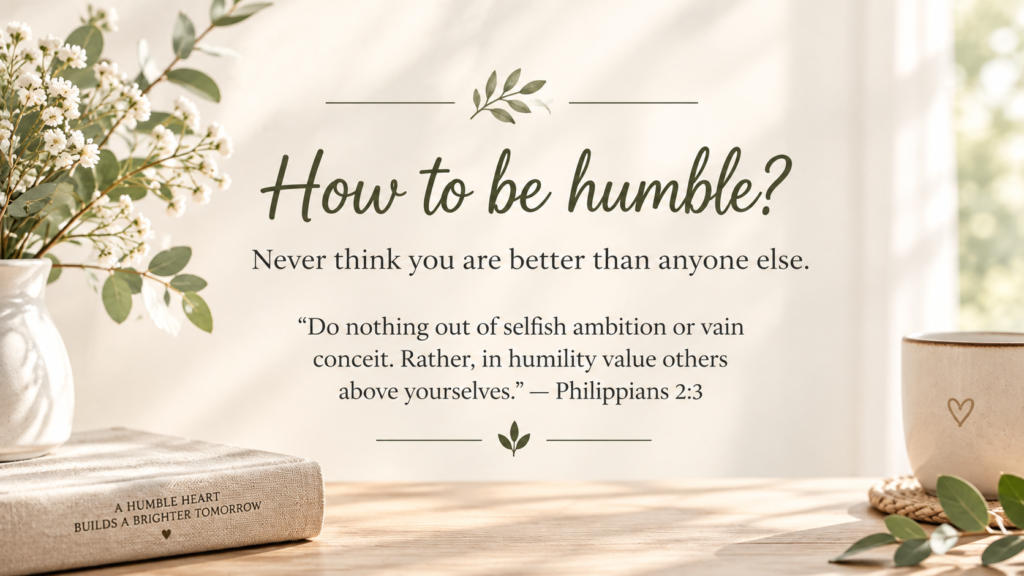
Learning how to be humble does not mean thinking you are worthless, hiding your strengths, or allowing people to treat you badly. True humility means seeing yourself honestly: recognizing your strengths without superiority, admitting your weaknesses without shame, remaining teachable, and treating other people with dignity.
For Christians, humility goes even deeper. Jesus provides the central model of a life shaped by service rather than selfish ambition. Philippians 2 calls believers to consider the interests of others and points directly to Christ’s humility. Bible Gateway
If you want to know how to be humble, begin with one simple shift: stop making every situation about proving your value. Listen more carefully. Admit when you’re wrong. Be grateful for what you have. Celebrate other people’s gifts. Serve when nobody is applauding.
Humility is not weakness.
It is strength that no longer needs to prove itself.
How to Be Humble in Everyday Life
The most practical answer to how to be humble is to develop habits that move your attention away from protecting your ego and toward truth, gratitude, growth, God, and other people.
Humility rarely arrives through one dramatic decision.
It develops through ordinary moments.
Someone corrects you.
Do you listen or immediately defend yourself?
Someone else succeeds.
Do you celebrate them or secretly compare yourself?
You make a mistake.
Do you admit it or search for someone to blame?
You receive praise.
Can you accept it gratefully without turning it into superiority?
These small moments reveal whether humility is becoming part of your character.
Here are 12 habits that can help.
1. See Yourself Honestly
The first step in learning how to be humble is developing an accurate view of yourself.
Humility does not require pretending you have no strengths.
If you are talented, you can acknowledge it.
If you worked hard for something, you can be grateful for the result.
If you achieved something meaningful, you do not have to deny it.
The difference is what you do with that knowledge.
Pride says:
“My strengths make me more important than other people.”
False humility says:
“I have no strengths at all.”
Healthy humility says:
“I have strengths and weaknesses, and so does everyone else.”
That balanced perspective protects you from both arrogance and unnecessary self-rejection.
A humble person does not need to become smaller.
They simply stop needing to appear bigger.
2. Admit When You Are Wrong
One of the clearest ways to practice how to be humble is learning to say:
“I was wrong.”
No excuses.
No long explanation designed to transfer responsibility.
No carefully worded apology that secretly blames the other person.
Mistakes can feel threatening because the ego interprets them as evidence that we are inadequate.
Humility sees them differently.
Being wrong about something does not make you worthless.
It makes you human.
Try replacing defensive responses with simple sentences:
“I misunderstood.”
“You were right about that.”
“I should have handled it differently.”
“I didn’t know that.”
“I made a mistake. I’m sorry.”
Those sentences may feel uncomfortable at first.
But they build trust.
People usually feel safer around someone who can admit a mistake than someone who must always appear correct.
3. Listen Before You Speak
If you’re wondering how to be humble in conversations, begin by listening without preparing your next response.
Many people appear to listen while actually waiting for their turn to speak.
Humility approaches conversation differently.
It becomes curious.
What does this person know that I don’t?
What have they experienced that I haven’t?
Could I have misunderstood their point?
What can I learn here?
Listening does not require agreeing with everything another person says.
It means respecting them enough to understand before responding.
Try asking one additional question before offering your opinion.
That small habit can transform conversations.
Instead of immediately saying, “Here’s what I think,” ask:
“Can you explain what you mean?”
Humility grows when curiosity becomes stronger than the need to dominate a conversation.
4. Stop Needing to Win Every Argument
Learning how to be humble becomes difficult when every disagreement feels like a competition.
Sometimes you are right.
Sometimes the other person is right.
Sometimes both of you understand different parts of the situation.
And sometimes the disagreement simply does not need a winner.
Ask yourself:
Am I trying to discover what is true, or am I trying to prove that I am right?
Those are very different goals.
A humble person can hold a strong conviction without treating everyone who disagrees as foolish.
They can also change their mind when better information appears.
That does not make them weak.
It makes them teachable.
You do not lose dignity when you change your mind because you learned something.
You gain wisdom.
5. Ask for Advice and Accept Correction
One powerful answer to how to be humble is deliberately inviting perspectives you do not already have.
Ask someone you trust:
“What am I overlooking?”
“Where could I improve?”
“Was there a better way I could have handled that?”
“What would you do differently?”
Then resist the urge to defend yourself.
Feedback does not automatically mean the other person is correct. Humility does not require accepting every criticism as truth.
It means examining criticism honestly before rejecting it.
Separate the message from the discomfort.
Ask whether there is something useful inside it.
Even poorly delivered criticism can occasionally contain valuable information.
The goal isn’t to become controlled by other people’s opinions.
It is to remain teachable enough to learn when correction is deserved.
6. Celebrate Other People’s Success
You learn a great deal about how to be humble when someone else receives the opportunity, recognition, promotion, attention, or success you wanted.
Pride turns another person’s success into a threat.
Humility does not.
It says:
“Their success does not diminish my worth.”
Give sincere compliments.
Recommend talented people.
Share credit.
Celebrate a friend’s achievement without immediately talking about your own.
Tell someone when their work helped you.
If jealousy appears, don’t pretend it isn’t there.
Notice it.
Then deliberately practice gratitude and generosity.
One of the strongest signs of humility is being able to stand beside someone else’s moment without trying to make it yours.
7. Practice Gratitude Every Day
Gratitude is one of the simplest habits for anyone learning how to be humble.
Pride tends to say:
“I earned everything myself.”
Gratitude remembers the fuller story.
Someone taught you.
Someone encouraged you.
Someone opened a door.
Someone gave you another chance.
You benefited from opportunities you did not create entirely by yourself.
For Christians, gratitude reaches further: life, ability, grace, relationships, provision, and every good gift ultimately become reasons to thank God.
Try naming three things each evening for which you are grateful.
Make at least one of them something another person contributed to your life.
Gratitude reminds us that we are recipients as well as achievers.
8. Serve Without Needing Recognition
Anyone serious about how to be humble should occasionally do something good that nobody will applaud.
Help without announcing it.
Clean something you did not dirty.
Encourage someone who cannot advance your career.
Give quietly.
Let another person take the better seat.
Do an unnoticed task.
Serve someone who cannot repay you.
Why does this matter?
Because recognition can quietly become the reward we are really seeking.
There is nothing wrong with being appreciated.
The question is whether appreciation has become necessary before we are willing to help.
Humility learns to do good even when nobody is watching.
9. Give Credit Generously
A practical lesson in how to be humble is learning to use the word “we” when success genuinely belonged to more than one person.
Imagine a project succeeds.
A prideful response highlights your contribution while quietly erasing everyone else’s.
Humility remembers the team.
Say:
“Sarah caught an important problem early.”
“My team did excellent work.”
“I couldn’t have finished this without their help.”
“My teacher showed me how to do this.”
“I learned this from someone else.”
Giving credit does not reduce your contribution.
It makes your account of success more accurate.
And accuracy is one of humility’s foundations.
10. Let Your Actions Speak More Often
If you want to understand how to be humble, notice how often you feel compelled to tell people about your achievements.
There are appropriate times to discuss accomplishments.
A résumé, interview, portfolio, performance review, or professional introduction may require it.
Humility does not mean sabotaging yourself professionally.
The problem begins when every conversation becomes an opportunity to establish status.
You don’t need to mention every achievement.
You don’t need to have the best story in every conversation.
You don’t need to prove that you’ve been somewhere better, accomplished something bigger, or know someone more important.
Sometimes you can simply listen.
Quiet confidence does not require constant advertising.
11. Remember That Everyone Can Teach You Something
A surprisingly effective approach to how to be humble is entering conversations with the assumption that every person knows something you don’t.
A younger person may understand something you have never encountered.
An employee may see a problem a manager misses.
A beginner may ask a question an expert stopped asking years ago.
Someone from another culture may reveal assumptions you never realized you carried.
A child may notice something simple that adults overcomplicate.
Humility does not judge the value of information entirely by the status of the person offering it.
Remain curious.
The moment you believe nobody around you has anything left to teach you, pride has probably already begun closing doors.
12. Follow the Humility of Jesus
For Christians, the deepest answer to how to be humble is not merely a technique.
It is a Person.
Philippians 2 presents Jesus as the model of humility and calls believers to adopt a mindset concerned with others rather than selfish ambition.
You can read the chapter here:
Jesus’ humility was not insecurity.
He did not lack identity.
He did not become powerless because He served.
Christian humility therefore does not mean denying your worth.
It means refusing to make your worth a reason to place yourself above others.
When Christians ask how to be humble, Jesus redirects the question:
How can I serve?
How can I obey God?
How can I care about someone else’s needs?
How can I stop making myself the center?
That is humility expressed through love.
What Does It Really Mean to Be Humble?
Before practicing how to be humble, it helps to remove a common misconception.
Humility is not humiliation.
Humiliation is the experience of being degraded, embarrassed, or stripped of dignity.
Humility is a chosen posture of accurate self-understanding, teachability, and respect for others.
A humble person can say:
“I did that well.”
They can also say:
“I need help.”
They can accept praise.
They can admit failure.
They can lead.
They can follow.
They can speak confidently.
They can remain silent when someone else deserves attention.
True humility is not believing you are less valuable than everyone else.
It is realizing you do not need to be more valuable than everyone else.
Humility Is Not Low Self-Esteem
This distinction matters enormously when learning how to be humble.
Low self-esteem says:
“I am not good enough.”
Humility says:
“I don’t have to be perfect.”
Low self-esteem may cause someone to reject every compliment.
Humility can receive a compliment with a simple:
“Thank you.”
Low self-esteem can make a person afraid to speak.
Humility can speak courageously without needing to dominate.
Low self-esteem focuses heavily on perceived inadequacy.
Humility can actually make a person less self-absorbed because they are secure enough to pay attention to others.
You do not become humble by hating yourself.
Can You Be Humble and Confident?
Yes.
In fact, learning how to be humble can produce a healthier kind of confidence.
Arrogance says:
“I must be better than you.”
Insecurity says:
“I am probably worse than you.”
Humility says:
“I don’t need to measure my worth against yours.”
That distinction is freeing.
You can know what you’re good at without believing your abilities make you superior.
You can lead without treating people beneath you as less important.
You can disagree without disrespect.
You can accept a compliment without turning it into a speech about yourself.
Humility and confidence are not enemies.
Healthy confidence can make humility easier because you no longer need constant comparison.
How to Be Humble According to the Bible
Christians wondering how to be humble find the theme throughout Scripture.
Biblical humility begins with recognizing God’s greatness and our dependence upon Him.
It then changes how we treat other people.
Philippians 2 connects humility with considering others.
James teaches believers to humble themselves before God.
Romans warns against thinking of ourselves more highly than we ought.
Peter connects humility with relationships and dependence upon God.
Jesus repeatedly turns ordinary ideas of status upside down through service.
The biblical picture is therefore not:
“Pretend you have no value.”
It is closer to:
Know who God is. Know who you are. Receive grace gratefully. Serve others faithfully.
That is very different from self-hatred.
How Jesus Demonstrated Humility
For Christians learning how to be humble, Jesus provides a model that combines humility with extraordinary strength.
He served.
He listened.
He showed compassion toward people overlooked by society.
He washed His disciples’ feet.
He taught that greatness is connected with service.
He obeyed the Father.
He willingly took the role of a servant.
This matters because Jesus’ example challenges the assumption that humble people must be timid.
Christian humility can be courageous.
It can confront wrongdoing.
It can lead.
It can speak truth.
What it does not need is selfish ambition, superiority, or constant recognition.
How to Be Humble Before God
Another dimension of how to be humble involves your relationship with God.
Start by admitting that you do not control everything.
Pray honestly.
Confess when you have done wrong.
Thank God for your gifts instead of treating them as reasons for superiority.
Ask for wisdom when you don’t know what to do.
Read Scripture with a willingness to be corrected rather than merely searching for passages that confirm what you already believe.
Humility before God says:
“I need You.”
For many people, those three words are harder than they sound.
Pride wants complete independence.
Faith recognizes dependence.
How to Be Humble in Relationships
If you’re learning how to be humble with a spouse, family member, or friend, pay attention to how you handle conflict.
Do you interrupt?
Do you keep score?
Do you apologize only when the other person apologizes first?
Do you need the last word?
Do you turn every disagreement into a trial where your goal is proving innocence?
Humility changes the objective.
Instead of asking:
“How can I win?”
Ask:
“How can we understand what happened?”
A humble apology might sound like:
“I was impatient with you, and that wasn’t fair. I’m sorry.”
Notice what is missing.
There is no “but you also…”
Take responsibility for your part.
You can discuss the other person’s behavior separately.
How to Be Humble at Work
Professional environments are excellent places to practice how to be humble because status, recognition, competition, and criticism are often unavoidable.
Give coworkers credit.
Ask questions when you don’t know something.
Don’t pretend to understand instructions you did not understand.
Thank people whose work makes yours possible.
When you lead, invite disagreement.
When a junior colleague has the better idea, use it and acknowledge them.
When you make a mistake, correct it instead of hiding it.
At the same time, humility does not require underselling yourself.
You can explain your achievements in an interview.
You can negotiate fair compensation.
You can seek promotion.
You can disagree with your manager.
The difference is whether ambition requires treating others as stepping stones.
How to Be Humble on Social Media
Modern life adds another challenge to how to be humble: constant opportunities for comparison and self-promotion.
Before posting something, occasionally ask:
Why am I sharing this?
There is nothing inherently wrong with sharing achievements, celebrations, photos, or good news.
But patterns matter.
Do you become anxious when posts receive little attention?
Do you exaggerate accomplishments?
Do you secretly hope a post makes someone jealous?
Do you measure your life against carefully selected highlights from other people’s lives?
Try celebrating something without posting it.
Enjoy an accomplishment privately.
Encourage another creator publicly.
Credit the person whose idea inspired yours.
Humility becomes stronger when every meaningful experience does not require an audience.
How to Stay Humble When You Become Successful
Success can make how to be humble harder because praise begins arriving more frequently.
Remember who helped you.
Keep people around you who can tell you the truth.
Do ordinary tasks.
Stay connected to people who knew you before the achievement.
Continue learning.
Treat service workers, assistants, junior employees, and strangers with the same dignity you give powerful people.
And remember:
Your accomplishments may describe what you have done.
They do not determine how much another human being is worth.
Success becomes dangerous when achievement quietly turns into entitlement.
How to Accept Praise Humbly
People sometimes misunderstand how to be humble and reject every compliment.
Someone says:
“You did an amazing job.”
And they respond:
“No, it was terrible.”
That is not necessary.
Try:
“Thank you. I really appreciate that.”
If others contributed, acknowledge them naturally:
“Thank you. The team helped enormously.”
You don’t need to insult your own work to prove that you’re humble.
Receive appreciation with gratitude rather than either arrogance or self-deprecation.
How to Handle Criticism With Humility
Few situations test how to be humble faster than criticism.
Before responding, ask three questions:
Is it true?
Is part of it true?
Is there something useful I can learn even if I dislike how it was delivered?
If the criticism is accurate, own it.
If it is partly accurate, take responsibility for your part.
If it is false, you can disagree calmly.
Humility does not mean allowing false accusations to stand unchallenged.
The goal is not passive submission.
The goal is being more committed to truth than to protecting your ego.
Signs You Are Becoming More Humble
You may be making progress in how to be humble when you notice these changes:
You can say “I don’t know” without embarrassment.
You apologize more quickly.
You interrupt less.
You ask more questions.
You can celebrate someone else’s success.
You feel less threatened by talented people.
You accept compliments without boasting or rejecting them.
You can change your opinion.
You give credit naturally.
You don’t need the final word.
You are more interested in learning than appearing knowledgeable.
You serve even when nobody notices.
None of these means you have “finished” becoming humble.
Humility is a continuing practice.
Signs Pride May Be Getting in the Way
Sometimes the best way to understand how to be humble is to recognize what pride looks like in ordinary life.
Watch for patterns such as:
Needing to be right constantly.
Interrupting because your point feels more important.
Becoming defensive at almost every correction.
Taking credit while minimizing other people’s contributions.
Feeling threatened by another person’s success.
Refusing to apologize first.
Pretending to know things you don’t know.
Treating people differently according to status.
Talking frequently about your achievements.
Assuming disagreement means disrespect.
None of these automatically makes someone an arrogant person.
Everyone can behave pridefully sometimes.
The useful question is whether you are willing to notice the pattern and change it.
A 7-Day Humility Challenge
If you want to practice how to be humble rather than merely read about it, try this simple seven-day challenge.
Day 1 — Listen.
Have one conversation where your goal is understanding rather than impressing.
Day 2 — Admit.
Own one mistake without making an excuse.
Day 3 — Appreciate.
Tell someone specifically what you value about them.
Day 4 — Learn.
Ask someone to teach you something.
Day 5 — Serve.
Do something helpful without seeking recognition.
Day 6 — Reflect.
Think about a recent disagreement and identify where you might have been wrong.
Day 7 — Give thanks.
Write down five gifts, opportunities, or people you did not create entirely through your own effort.
Then repeat.
Humility grows through practice, not merely intention.
10 Original Quotes About Humility
These original reflections can reinforce how to be humble in everyday life:
1. “Humility begins when being truthful becomes more important than being impressive.”
2. “You do not have to make yourself smaller to make room for someone else.”
3. “A humble heart can celebrate another person’s light without believing its own has grown dim.”
4. “Wisdom grows faster when we stop pretending we already know everything.”
5. “An apology becomes powerful when it stops searching for excuses.”
6. “True confidence does not need another person to feel inferior.”
7. “Gratitude remembers the hands that helped us reach places pride claims we reached alone.”
8. “Listening is humility expressed through attention.”
9. “The strongest person in the room may be the one who can sincerely say, ‘I was wrong.’”
10. “Humility does not erase your gifts; it teaches you how to carry them graciously.”
A Short Prayer for Humility
For Christians exploring how to be humble, prayer can turn the lesson inward.
Lord,
Teach me to see myself honestly.
Keep pride from making me feel superior and insecurity from making me forget the worth You have given me.
Help me listen before speaking, admit when I am wrong, and receive correction without immediately becoming defensive.
Give me joy when others succeed.
Teach me to serve when nobody notices.
Help me remember that my gifts are not reasons to look down on anyone.
When pride rises in me, replace it with gratitude.
When I want recognition, remind me of Jesus’ example of service.
Give me a heart that is teachable, gracious, courageous, and kind.
May my life reflect humility not only in my words, but in the way I treat people every day.
Amen.
FAQs About How to Be Humble
How can I become a more humble person?
The practical answer to how to be humble is to develop habits of honest self-awareness, listening, gratitude, accountability, service, and teachability. Admit mistakes, seek feedback, celebrate other people’s success, and stop treating every disagreement as something you must win.
What does being humble really mean?
Humility means having an accurate rather than inflated view of yourself while remaining open to learning and attentive to other people. It does not require believing you are worthless or denying your genuine strengths.
How can I be humble without losing confidence?
Learning how to be humble does not require losing confidence. Healthy humility allows you to acknowledge your strengths while recognizing that they do not make you more valuable than others. Confidence describes what you can do; humility shapes how you carry it.
What does the Bible say about being humble?
The Bible repeatedly encourages humility before God and toward others. Philippians 2 particularly connects humility with considering others and presents Jesus Christ as the Christian model of humble service.
How did Jesus show humility?
Jesus demonstrated humility through service, obedience, compassion, and concern for others. Philippians 2 presents His willingness to take the form of a servant as central to the Christian understanding of humility.
Can a humble person be a strong leader?
Yes. Understanding how to be humble does not mean becoming passive. Humble leaders can make difficult decisions and speak confidently while remaining teachable, sharing credit, acknowledging mistakes, and listening to other perspectives.
How do I know if I am prideful?
Possible signs include constant defensiveness, difficulty apologizing, needing the final word, exaggerating achievements, minimizing others’ contributions, feeling threatened by another person’s success, and refusing to admit when you don’t know something.
How can I become humble when someone criticizes me?
Pause before defending yourself. Ask whether the criticism is true, partly true, or useful. Accept valid correction and calmly reject inaccurate claims. Humility means being committed to truth, not automatically agreeing with every critic.
Is humility the same as low self-esteem?
No. A crucial lesson in how to be humble is distinguishing humility from self-rejection. Low self-esteem undervalues the self; healthy humility aims for an honest view of both strengths and limitations while recognizing the dignity of others.
How can I practice humility every day?
Listen carefully, thank people, admit mistakes, ask questions, share credit, perform unnoticed acts of service, accept correction thoughtfully, and deliberately celebrate someone else’s success.
How can Christians overcome pride?
Christians can address pride through prayer, Scripture, gratitude, confession, service, remembering their dependence upon God’s grace, and following Jesus’ example of humility. The goal is not self-hatred but a God-centered and other-conscious life.
Can you become too humble?
If “humility” means tolerating abuse, denying your abilities, never speaking up, or believing everyone matters except you, that is not healthy humility. Learning how to be humble should produce honesty and graciousness, not erase appropriate boundaries or self-respect.
Final Thoughts
Learning how to be humble is not about disappearing.
It is about becoming secure enough that you no longer need to be the center of every room.
You can be talented and humble.
Successful and humble.
Confident and humble.
A leader and humble.
You can know your strengths while remaining aware of your limitations.
You can receive praise without becoming addicted to it.
You can disagree without belittling people.
You can succeed without forgetting who helped you.
For Christians, how to be humble ultimately leads back to Jesus. His example shows that humility and strength can exist together, and that greatness can express itself through service.
Start small.
Listen before speaking.
Say “I don’t know” when you don’t know.
Say “I was wrong” when you were wrong.
Thank the people who helped you.
Celebrate someone else’s success.
Serve when nobody is watching.
And remember one simple principle:
Humility isn’t thinking you have nothing to offer. It is knowing you have something to offer without needing to believe you are better than everyone else.
LOOKING FOR SOME MORE ENGAGING CONTENT: