John the Baptist Parents: The Remarkable Story of Zechariah and Elizabeth
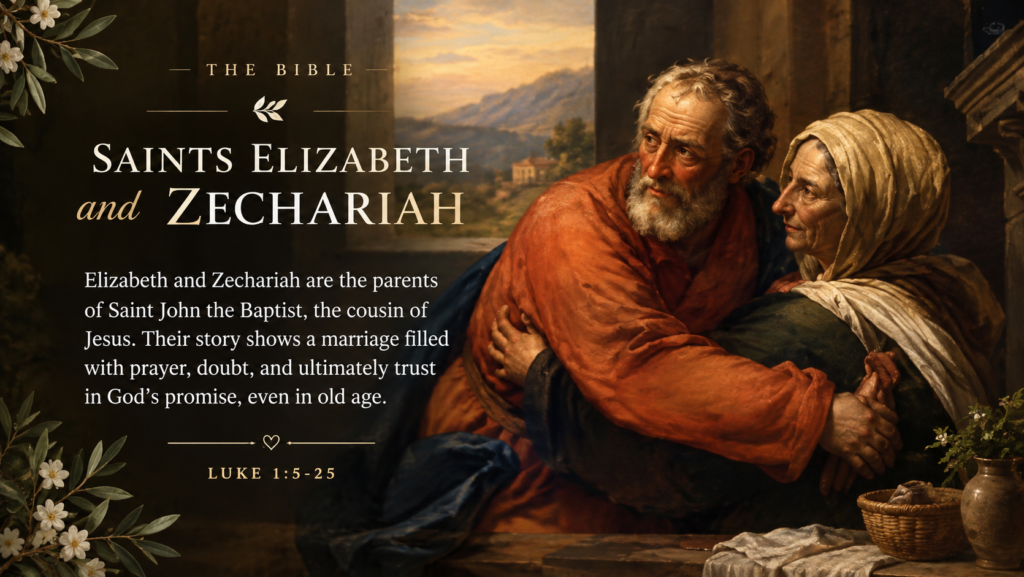
John the Baptist parents — Zechariah and Elizabeth — are two of the most quietly extraordinary people in the entire Bible. They were not kings. They were not prophets with famous names. They were an elderly couple who had prayed the same prayer for decades without an answer, continued serving God anyway, and then became the parents of the man who would prepare the world for Jesus Christ.
Their story is found in the first chapter of Luke. It takes up only a few pages. But what happened in those pages — an angelic visit, nine months of silence, a miraculous pregnancy, and a name written on a tablet — set in motion one of the most important births in human history.
This is their story, told in full.
Who Were John the Baptist Parents — Zechariah and Elizabeth?
Luke 1:5–6 introduces them with two sentences that say everything: “In the time of Herod king of Judea there was a priest named Zechariah, who belonged to the priestly division of Abijah; his wife Elizabeth was also a descendant of Aaron. Both of them were righteous in the sight of God, observing all the Lord’s commands and decrees blamelessly.”
Righteous. Blameless. Both of them.
Zechariah was a priest — a descendant of Aaron, from the division of Abijah. This was a working priesthood, organized into twenty-four divisions that rotated service in the Jerusalem temple. Zechariah was not a famous priest. He was one of hundreds who served their appointed weeks and then returned home to ordinary life in the hill country of Judea.
Elizabeth was also from the priestly line of Aaron — which made their marriage a union of deep religious heritage on both sides. She is one of only a handful of women in the New Testament described with this kind of direct moral commendation. She was not introduced as a wife who supported her husband’s ministry. She was described as righteous and blameless in her own right.
And yet — Luke 1:7 adds the detail that changes everything: “But they were childless because Elizabeth was not able to conceive, and they were both very old.”
The two most painful words in that verse are “both old.” They had not just been waiting for a child. They had been waiting long enough that waiting was over. The season of hoping had passed. They were elderly, childless, and as far as human biology was concerned, that was the end of the story.
The Day Everything Changed — Zechariah in the Temple
The division of Abijah came up for temple service, and Zechariah went to Jerusalem to fulfill his priestly duties. Among those duties, the priests would cast lots to determine who would enter the inner sanctuary to burn incense on the altar — a deeply sacred task that a priest might perform only once in his entire lifetime, if at all.
The lot fell to Zechariah.
He entered the sanctuary alone. The people outside were gathered in prayer. And then — standing at the right side of the altar of incense — the angel Gabriel appeared.
Luke 1:12 says simply: “When Zechariah saw him, he was startled and was gripped with fear.”
Gabriel’s first words were a command that appears more than 300 times across Scripture in various forms: “Do not be afraid.” Then came the announcement that would have seemed completely impossible to the elderly priest standing in that sacred room:
“Do not be afraid, Zechariah; your prayer has been heard. Your wife Elizabeth will bear you a son, and you are to call him John. He will be a joy and delight to you, and many will rejoice because of his birth, for he will be great in the sight of the Lord.” (Luke 1:13–15, NIV)
Notice the specific phrase: your prayer has been heard. God did not say Zechariah’s prayer had been forgotten. He did not say the prayer had been denied. He said it had been heard — and was now being answered. This was a prayer that had been prayed perhaps for thirty or forty years. And God had been listening to every single word of it.
Gabriel continued with details about who this child would be. He would never drink wine or fermented drink. He would be filled with the Holy Spirit from birth. He would bring many of the people of Israel back to God. He would go before the Lord in the spirit and power of Elijah, turning hearts of fathers to their children, and the disobedient to the wisdom of the righteous — to make ready a people prepared for the Lord.
This was not just a baby announcement. It was the fulfillment of the last prophecy in the Old Testament. Malachi 4:5–6 had promised that Elijah would come before the great and dreadful day of the Lord. Gabriel was saying: that prophecy. This child. Your son.
Zechariah’s Doubt and Nine Months of Silence
Zechariah’s response to Gabriel’s announcement is one of the most honest moments in the New Testament. He asked: “How can I be sure of this? I am an old man and my wife is well along in years.” (Luke 1:18, NIV)
It was a reasonable question. It was also the wrong response to an angel standing in the presence of God.
Gabriel’s reply was firm: “I am Gabriel. I stand in the presence of God, and I have been sent to speak to you and to tell you this good news. And now you will be silent and not able to speak until the day this happens, because you did not believe my words, which will come true at their appointed time.” (Luke 1:19–20, NIV)
Zechariah walked out of the sanctuary unable to speak. The people waiting outside realized immediately that something had happened — he kept making signs to them and remained unable to speak. When his time of service was completed, he returned home.
And Elizabeth conceived.
For nine months, Zechariah could not speak a single word. He could not tell his wife what the angel had said — she had to discover the promise through the pregnancy itself. He could not announce to his neighbors what was coming. He could not explain the silence to anyone.
But silence was not punishment without purpose. Nine months of being unable to speak is also nine months of being forced to listen — to sit with what God had said, to watch it unfold exactly as promised, to have every doubt quietly dismantled by the growing evidence of Elizabeth’s changing body.
When his voice finally returned — at the moment he confirmed his son’s name was John — his first recorded words were not complaints about the nine months of silence. They were worship. The Benedictus, one of the most beautiful songs in the New Testament, poured out of him immediately. Silence had not broken him. It had filled him.
Elizabeth — Faith, Disgrace, and the Visit of Mary
Elizabeth’s response to her pregnancy is recorded in Luke 1:24–25: “After this his wife Elizabeth became pregnant and for five months remained in seclusion. ‘The Lord has done this for me,’ she said. ‘In these days he has shown his favor and taken away my disgrace among the people.'”
The word “disgrace” is significant. In the ancient world, a woman who did not bear children carried a social weight that modern readers may underestimate. It was not just personal sadness — it was public shame. People around her would have drawn conclusions about her standing before God. Elizabeth had carried that weight for decades, remaining righteous and blameless despite it.
Now she withdrew for five months. Not to hide, but to absorb. To be alone with God and this miracle growing inside her before the world knew about it.
In her sixth month of pregnancy, something happened that elevated Elizabeth’s story from remarkable to extraordinary. Her young relative Mary — newly pregnant with Jesus — came to visit her.
The moment Mary arrived and called out a greeting, the baby in Elizabeth’s womb leaped. And Elizabeth, filled with the Holy Spirit, cried out in a loud voice: “Blessed are you among women, and blessed is the child you will bear! But why am I so favored, that the mother of my Lord should come to me? As soon as the sound of your greeting reached my ears, the baby in my womb leaped for joy.” (Luke 1:42–44, NIV)
Elizabeth was the first person on earth to recognize Mary as the mother of the Messiah. The Holy Spirit revealed it to her — through a leap in the womb and a declaration that came out of her before she could even fully process what she was saying. This elderly woman, who had spent decades in patient faithfulness, became the first to greet the mother of the Lord.
The Birth of John and the Return of Zechariah’s Voice
When the baby was born and the neighbors and relatives came to celebrate, they assumed he would be named after his father — Zechariah. Elizabeth said no. His name would be John.
The people around her were surprised. “There is no one among your relatives who has that name,” they said. They turned to Zechariah, making signs to ask what he wanted the baby named.
He asked for a writing tablet and wrote: “His name is John.” (Luke 1:63, NIV)
Immediately his mouth opened and his tongue was freed. His first words were praise to God.
What followed was the Benedictus — Zechariah’s song of prophecy — one of the most theologically rich passages in the Gospel of Luke. In it, Zechariah spoke about the redemption God was bringing to Israel, the covenant He was keeping with Abraham, and the specific role his son John would play:
“And you, my child, will be called a prophet of the Most High; for you will go on before the Lord to prepare the way for him, to give his people the knowledge of salvation through the forgiveness of their sins, because of the tender mercy of our God, by which the rising sun will come to us from heaven to shine on those living in darkness and in the shadow of death, to guide our feet into the path of peace.” (Luke 1:76–79, NIV)
After nine months of silence, these were Zechariah’s first words. Not complaints. Not explanations. Pure prophecy and worship.
Lessons From the Story of John the Baptist’s Parents
The story of Zechariah and Elizabeth carries lessons that reach far beyond their historical moment.
Faithfulness is not the same as ease. Zechariah and Elizabeth were righteous and blameless — and they still spent decades without the answer they wanted. Their obedience did not protect them from long seasons of unanswered prayer. It simply meant they were still standing when the answer finally came.
God hears prayers that seem forgotten. Gabriel told Zechariah that his prayer had been heard. Not “God is finally answering.” Not “God changed his mind.” The prayer had been heard all along. The answer was being held at exactly the right moment for exactly the right purpose.
Doubt does not disqualify you. Zechariah doubted. He was silenced for it — but he was not removed from the story. He still became the father of John. He still spoke the Benedictus. God used his doubt as a container for nine months of preparation, not as a reason to choose someone else.
Ordinary faithfulness prepares the way for extraordinary purpose. Zechariah showed up to his priestly duties. He did his appointed week of service. He burned the incense. In the middle of that completely ordinary act of faithfulness, he encountered the most significant moment of his life. The extraordinary does not usually arrive outside of the ordinary — it arrives in the middle of it.
The people who wait the longest sometimes carry the greatest gifts. Elizabeth waited decades. When she finally spoke, she was the first to recognize the mother of the Messiah. Her years of waiting had not diminished her sensitivity to the Holy Spirit — they had deepened it.
Frequently Asked Questions About John the Baptist Parents
Who were John the Baptist’s parents?
John the Baptist’s parents were Zechariah and Elizabeth. Zechariah was a priest from the division of Abijah, a descendant of Aaron. Elizabeth was also from the priestly line of Aaron. Both are described in Luke 1:6 as righteous before God and blameless in all His commands. They were elderly and childless when the angel Gabriel announced that Elizabeth would conceive and bear a son named John.
What tribe were Zechariah and Elizabeth from?
Both Zechariah and Elizabeth were from the tribe of Levi — specifically from the priestly line of Aaron. Zechariah served in the priestly division of Abijah, one of the twenty-four divisions established by King David for rotating temple service (1 Chronicles 24:10). Elizabeth’s lineage from Aaron is specifically mentioned in Luke 1:5.
How old were Zechariah and Elizabeth when John was born?
The Bible does not give a specific age. Luke 1:7 says they were “both very old” and that Elizabeth was past the age of childbearing. Many Bible scholars suggest they were likely in their sixties or older — an age at which natural conception was considered completely impossible.
Why was Zechariah struck mute?
Zechariah was struck mute because he doubted the angel Gabriel’s announcement. When Gabriel told him that Elizabeth would bear a son, Zechariah asked how he could be sure since they were both old. Gabriel responded that because Zechariah did not believe the words spoken to him, he would be unable to speak until the day the promise was fulfilled. His silence lasted approximately nine months — until the day his son was born and he confirmed the name John.
What is the relationship between Elizabeth and Mary?
Luke 1:36 describes Elizabeth as Mary’s relative — the Greek word used is “syngenis,” which can mean cousin, kinswoman, or relative. The exact nature of the relationship is not specified. What is clear is that they were close enough for Mary to travel to visit Elizabeth immediately after the angel Gabriel announced her own pregnancy, and that their pregnancies overlapped — Elizabeth was six months pregnant when Mary conceived Jesus.
Why did Elizabeth stay in seclusion for five months?
Luke 1:24 records that Elizabeth remained in seclusion for five months after conceiving. The Bible does not give a specific reason. Many scholars suggest she withdrew to spend time privately with God, to allow her pregnancy to become undeniable before going public, or simply to absorb the magnitude of what was happening. Her own explanation when she finally spoke focused on God’s favor in removing her disgrace — suggesting deep personal reflection during those months.
What was the Benedictus?
The Benedictus is the song of praise that Zechariah spoke immediately after his voice was restored at John’s naming. It is recorded in Luke 1:68–79. In it, Zechariah prophesied about God’s redemption of Israel, the fulfillment of the covenant with Abraham, and the specific role his son John would play as the one who would go before the Lord to prepare the way. The name “Benedictus” comes from the Latin translation of its opening word — “blessed.”
How does the story of Zechariah and Elizabeth relate to Abraham and Sarah?
The parallel is intentional. Like Abraham and Sarah, Zechariah and Elizabeth were elderly and childless when God promised them a son. Like Sarah, Elizabeth had been barren. Like Abraham, Zechariah initially doubted the announcement. And like Isaac, John was a child of promise — born through miraculous divine intervention to parents who were past the natural age of childbearing. The Gospel of Luke appears to deliberately echo the Genesis narrative to show that the God who worked in Abraham’s story was working again in theirs.
Final Thought: The People Who Wait the Longest Shape History the Most
Zechariah and Elizabeth did not set out to be important people. They set out to be faithful ones — and they succeeded at that for their entire lives, even through decades of silence from heaven and decades of social shame on earth.
What God was doing in their waiting was not visible to them while they were inside it. It never is. But looking back from outside the story, it is impossible to miss: God was preparing two people whose character, patience, and spiritual sensitivity would shape the upbringing of the man who would prepare the world for Jesus.
John the Baptist did not come from nowhere. He came from a home where faithfulness had been practiced for decades, where prayer had not been abandoned when it went unanswered, where God was trusted even when His timing made no sense. He came from John the Baptist parents who had been in training for this moment their entire lives — and who never knew it until the angel appeared.
If your prayers feel old and unanswered, the story of Zechariah and Elizabeth is not a promise that the answer will always be a baby. But it is evidence that God hears prayers that feel forgotten, that His timing has purpose even when it is painful, and that the people who wait longest sometimes carry the most important gifts of all.
To read the complete account of Zechariah and Elizabeth in Scripture, you can find Luke 1 in full on Bible Gateway — one of the most beautifully written chapters in the entire New Testament.
LOOKING FOR SOME MORE ENGAGING CONTENT: