Our Father Prayer: 100 Powerful Words, Meaning & Daily Guide
The Our Father prayer, also called the Lord’s Prayer, is the prayer Jesus taught His disciples. Its familiar words have comforted Christians for generations, offering a simple way to approach God with worship, trust, forgiveness, and hope.
Whether you are learning the prayer for the first time, returning to it after many years, or searching for its meaning, you can begin right here.
Quick answer: The Our Father begins, “Our Father, who art in heaven, hallowed be thy name.” It is found in Matthew 6:9–13, with a shorter form in Luke 11:2–4. The prayer teaches Christians to honor God, seek His will, ask for daily needs, forgive others, and seek protection from evil.
Our Father Prayer: Full Traditional Words
Here is the familiar traditional Christian version of the Lord’s Prayer, including the concluding words of praise used in many Protestant and Anglican traditions.
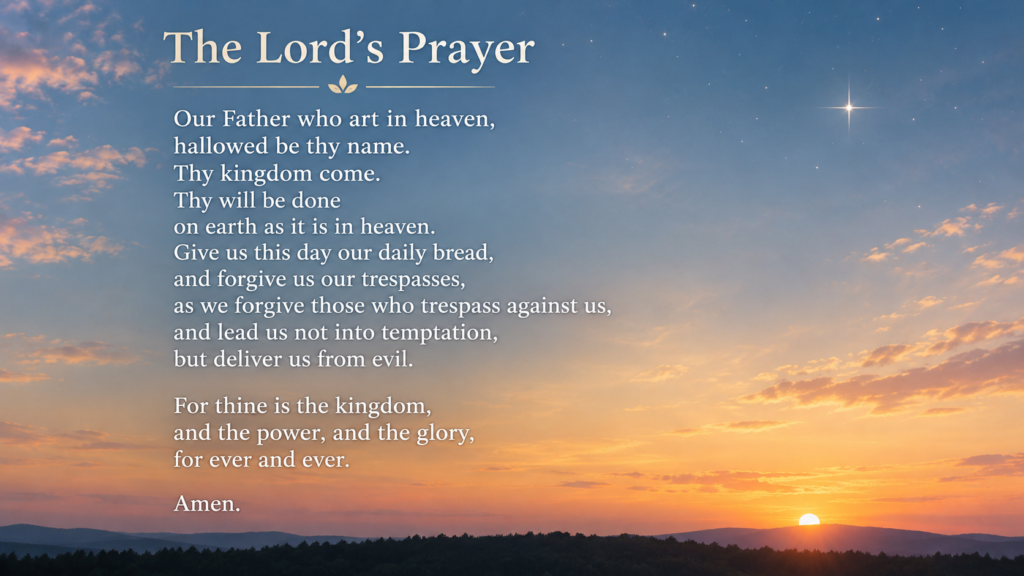
Our Father, who art in heaven,
Hallowed be thy name.
Thy kingdom come.
Thy will be done,
On earth as it is in heaven.Give us this day our daily bread.
And forgive us our trespasses,
As we forgive those who trespass against us.And lead us not into temptation,
But deliver us from evil.For thine is the kingdom,
And the power, and the glory,
For ever and ever.
Amen.
These traditional words are commonly used in English-speaking Christian worship. The wording and ending may vary depending on the church or denomination.
You do not need to rush through the prayer. Read it slowly, allowing each line to become an expression of faith rather than simply something to memorize.
The Catholic Our Father Prayer
Catholics traditionally pray the Our Father with the following wording:
Our Father, who art in heaven,
Hallowed be thy name.
Thy kingdom come.
Thy will be done
On earth as it is in heaven.Give us this day our daily bread,
And forgive us our trespasses,
As we forgive those who trespass against us,
And lead us not into temptation,
But deliver us from evil.
Amen.
In the Catholic Mass, the prayer is followed by additional liturgical words and a concluding doxology. In ordinary personal recitation, the familiar Catholic form ends after “deliver us from evil. Amen.”
The prayer expresses the same central Christian requests: reverence for God, trust in His will, daily provision, forgiveness, and protection.
The Lord’s Prayer in Modern English
Traditional words such as thy, thine, and hallowed can feel unfamiliar to modern readers.
Here is an original, simplified explanation in prayer form. This is a devotional paraphrase, not a replacement for the biblical or official liturgical text.
Our loving Father in heaven,
May your name always be honored.
May your kingdom come,
And may your will be done here on earth as it is in heaven.Please provide what we need today.
Forgive the wrong things we have done,
And help us forgive those who have hurt us.Guide us away from temptation,
Protect us from evil,
And teach us to live with faith and love.
Amen.
This paraphrase can help beginners understand the meaning before learning the traditional wording.
Where Is the Our Father Prayer Found in the Bible?
The Lord’s Prayer appears in two places in the New Testament:
- Matthew 6:9–13: Jesus teaches His disciples how to pray during the Sermon on the Mount.
- Luke 11:2–4: Jesus responds when a disciple asks Him to teach them to pray.
In Matthew, Jesus discusses sincere prayer and warns against praying merely to impress other people. He then offers a model that is direct, reverent, and deeply concerned with daily life.
Luke presents a shorter form of the prayer. Both accounts emphasize God’s holiness, His kingdom, daily provision, forgiveness, and faithful dependence.
You can read the passages in the King James Version of Matthew 6
The prayer is not simply a collection of comforting words. It is part of Jesus’ teaching about how people should approach God.
Our Father Prayer Meaning: Explained Line by Line
Each part of the Lord’s Prayer carries a lesson about the Christian relationship with God and with other people.
Understanding the words can make daily prayer more intentional and meaningful.
1. “Our Father, Who Art in Heaven”
Jesus begins with a relationship rather than a demand.
Calling God “Our Father” expresses the closeness, trust, and care associated with God’s fatherhood. The word “our” also reminds Christians that prayer is not only about individual needs. It connects believers with a wider community.
Personal reflection: When life feels lonely, these opening words can remind you that faith is not meant to be lived entirely alone.
2. “Hallowed Be Thy Name”
The word hallowed means holy or honored.
This line is a request that God’s name be treated with reverence. Before asking for help, the person praying recognizes God’s holiness.
Personal reflection: Begin with gratitude and worship, even when your heart is full of worries.
3. “Thy Kingdom Come”
Christians pray for God’s kingdom and His good purposes to be realized.
This includes a longing for justice, mercy, reconciliation, and lives shaped by God’s ways.
Personal reflection: Consider where you can practice compassion, honesty, and peace in your own community.
4. “Thy Will Be Done”
This line expresses trust in God’s wisdom.
It does not mean that every painful event is good or that Christians should stop making responsible choices. Rather, it invites humility when personal plans and circumstances are uncertain.
Personal reflection: You can ask God for guidance while still taking practical steps toward what is right.
5. “On Earth as It Is in Heaven”
This request connects faith with everyday life.
Christians are not only praying for a distant future. They are also asking that God’s goodness become visible in human relationships and decisions here and now.
Personal reflection: Let your words and actions reflect the kindness and integrity you ask God to bring into the world.
6. “Give Us This Day Our Daily Bread”
Daily bread represents dependence on God for life’s necessities.
Christians often understand this request as including physical needs such as food and shelter, as well as spiritual nourishment. Some traditions also connect it with the Eucharist.
Personal reflection: Instead of carrying every future worry at once, bring today’s needs before God.
7. “Forgive Us Our Trespasses”
The prayer recognizes that people make mistakes, hurt others, and fall short of what is right.
Asking for forgiveness involves honesty about wrongdoing and a willingness to turn toward a better way of living.
Personal reflection: Think about anything you need to acknowledge, repair, or change.
8. “As We Forgive Those Who Trespass Against Us”
Forgiveness is one of the prayer’s most challenging teachings.
It invites believers to extend mercy rather than hold on to revenge. Forgiveness does not mean pretending harm never happened, removing healthy boundaries, or remaining in an unsafe situation.
Personal reflection: You may need time, support, and wisdom to move toward forgiveness. Begin by asking God to help you respond without hatred.
9. “Lead Us Not Into Temptation”
Christians ask for help in resisting choices that could damage their relationship with God or others.
This is a prayer for guidance, moral strength, and awareness of personal weaknesses.
Personal reflection: Consider one temptation or harmful habit you want to approach with greater wisdom today.
10. “But Deliver Us From Evil”
This request expresses dependence on God’s protection.
It recognizes that people encounter fear, wrongdoing, spiritual struggles, and situations beyond their control.
Personal reflection: Bring your fears honestly to God while also seeking the practical help and protection you need.
11. “For Thine Is the Kingdom, the Power, and the Glory”
This concluding praise is known as the doxology.
It appears in many traditional Protestant and Anglican forms of the Lord’s Prayer, although it is not included in the earliest manuscripts of Matthew used by many modern Bible translations.
The doxology directs attention back to God’s sovereignty and glory.
Personal reflection: Ending with praise can remind you that your faith is grounded in God, not in your ability to control every outcome.
12. “Amen”
Amen expresses affirmation and agreement. It is often understood as “so be it.”
The final word is a way of sincerely affirming what has been prayed.
Personal reflection: Take a quiet moment before moving on with your day.
Why Is the Our Father Prayer So Powerful?
The strength of the Lord’s Prayer is not found in the number of times it is repeated or in a promise that particular words will produce a guaranteed result.
Its spiritual importance comes from the way Jesus taught His followers to pray.
The prayer begins with God rather than personal ambition. It moves from worship and trust to ordinary human needs, forgiveness, and protection.
It also uses the words “our,” “us,” and “we.” These remind believers to think beyond themselves.
Someone praying for daily bread is also reminded that other people need food. Someone asking for forgiveness is challenged to consider how they treat those who have hurt them.
In this way, the Lord’s Prayer invites both inward reflection and outward compassion.
12 Original Prayers Inspired by the Our Father
The following prayers are original devotional reflections inspired by the themes of the Lord’s Prayer. They are not alternate biblical versions and should not be presented as words directly spoken by Jesus.
1. Morning Prayer for Guidance
Heavenly Father, thank You for another morning. Help me begin this day with gratitude rather than worry. Guide my thoughts, my decisions, and the words I speak. Let my actions reflect Your love. Amen.
2. Prayer for Daily Needs
Father in heaven, You know what I need today. Please provide the strength, wisdom, and resources necessary for the responsibilities before me. Teach me to be grateful for what I have and generous toward those in need. Amen.
3. Prayer for Forgiveness
Merciful Father, I come to You honestly with my mistakes and regrets. Help me recognize where I have caused harm and give me the courage to make things right. Teach me to receive Your mercy with humility. Amen.
4. Prayer to Forgive Someone
Lord, You know the hurt I carry. I do not want bitterness to direct my life. Give me wisdom, patience, and the strength to move toward forgiveness while maintaining the boundaries needed for safety and healing. Amen.
5. Prayer for Protection
Heavenly Father, watch over me and those I love. Help us recognize danger, make wise decisions, and seek help when we need it. Give us courage in fearful moments and peace as we trust in Your care. Amen.
6. Prayer During Anxiety
Father, my thoughts feel restless today. Help me focus on what I can do now rather than everything that might happen tomorrow. Grant me calm, perspective, and the courage to ask for support. Amen.
7. Prayer for Family Unity
Loving Father, bless our family with patience and understanding. Help us listen before judging, apologize when we are wrong, and show kindness even when we disagree. May our home be a place of respect and peace. Amen.
8. Prayer Before Work
Lord, guide my work today. Help me be honest in my responsibilities, considerate toward others, and patient when challenges arise. Remind me that my worth is greater than my productivity. Amen.
9. Prayer for Spiritual Strength
Heavenly Father, strengthen my faith when I feel discouraged. Help me resist choices that lead me away from what is good. Give me the humility to learn, the courage to change, and the patience to keep growing. Amen.
10. Evening Prayer of Gratitude
Father, as this day comes to an end, thank You for the moments of kindness and provision I experienced. Forgive my mistakes, help me release unnecessary worries, and prepare my heart for peaceful rest. Amen.
11. Prayer for Someone in Need
Lord, I lift up those who are hungry, lonely, grieving, or afraid. Move us to respond with compassion rather than indifference. Help us share what we can and recognize the dignity of every person. Amen.
12. Prayer for Trusting God’s Will
Father in heaven, I bring You my hopes and plans. Help me work faithfully toward what is good while accepting that I cannot control every outcome. Give me wisdom for each decision and peace when the future remains uncertain. Amen.
Catholic and Protestant Versions: What’s the Difference?
The central message of the Lord’s Prayer is shared across Christian traditions, but some familiar English forms differ in wording and liturgical use.
| Feature | Common Catholic form | Common Protestant / Anglican traditional form |
|---|---|---|
| Opening | Our Father, who art in heaven | Our Father, who art in heaven |
| Forgiveness | Trespasses | Trespasses, debts, or sins depending on tradition |
| Final petition | Deliver us from evil | Deliver us from evil |
| Closing doxology | Not usually part of the standalone prayer | Often includes “For thine is the kingdom…” |
| Use | Mass, Rosary, personal prayer | Worship services, family prayer, personal devotion |
The difference in the ending does not mean Catholics reject the doxology. In the Catholic Mass, it is used separately after an additional prayer.
Why Do Some Versions Say “Debts” Instead of “Trespasses”?
In Matthew’s Gospel, the Greek wording uses language associated with debts. In the context of prayer, it refers to moral obligations and forgiveness, not simply financial loans.
English church traditions have used debts, trespasses, and sins to express this theme.
The essential message remains the same: Christians ask God for mercy and are called to show mercy to others.
How to Pray the Our Father Every Day
You can pray the Lord’s Prayer at any time. You do not need a special room, perfect concentration, or elaborate language.
A simple daily practice can help:
- Find a quiet moment. Sit comfortably or remain where you are if quiet space is unavailable.
- Begin slowly. Say the words without rushing.
- Pause at meaningful lines. Reflect on daily bread, forgiveness, or God’s will.
- Connect the words to your life. Think about one need, relationship, or decision you want to bring before God.
- Finish with gratitude. Allow a brief moment of silence after “Amen.”
Some people pray it in the morning before work. Others use it during evening reflection, family devotions, church services, or moments of uncertainty.
There is no need to treat prayer as a competition in length or frequency. Consistency and sincerity matter more than elaborate presentation.
A Simple Seven-Day Reflection Plan
If you are learning the prayer or want to understand it more deeply, spend one week reflecting on its main themes.
| Day | Focus | Reflection question |
|---|---|---|
| Monday | God as Father | Where do I need to trust God more deeply? |
| Tuesday | God’s holiness | How can I show reverence in daily life? |
| Wednesday | God’s kingdom and will | What would compassion look like in my decisions? |
| Thursday | Daily bread | What do I need today, and how can I help someone else? |
| Friday | Forgiveness | Is there a wrong I need to acknowledge or repair? |
| Saturday | Temptation | What choice requires greater wisdom or self-control? |
| Sunday | Protection and praise | What am I grateful for, and what fears can I bring to God? |
This plan is a devotional suggestion, not a prescribed church practice.
How to Teach the Our Father Prayer to Children
Children often learn prayers more easily when they understand the ideas behind the words.
Begin with the first line and explain that Christians speak to God as a loving heavenly Father.
Then introduce the prayer in short sections. For example:
- “Hallowed be thy name” means God’s name is holy and deserves respect.
- “Daily bread” means asking God for what we need.
- “Forgive us” means admitting mistakes and learning to forgive.
- “Deliver us from evil” means asking for help and protection.
Practice a few lines at a time rather than expecting children to memorize the entire prayer immediately.
You can also invite them to name one thing they are thankful for and one person they want to pray for.
When to Use the Lord’s Prayer
The Lord’s Prayer is appropriate for many moments in Christian life.
| Occasion | How it can help |
|---|---|
| Morning devotion | Begin the day with trust and gratitude |
| Bedtime prayer | Reflect, seek forgiveness, and rest |
| Family worship | Pray together using familiar words |
| Church services | Participate in communal Christian prayer |
| Times of uncertainty | Seek guidance and daily provision |
| After conflict | Reflect on forgiveness and reconciliation |
| When words are difficult | Return to the prayer Jesus taught |
| Children’s Bible study | Introduce foundational Christian teaching |
You may also pray the Our Father before or after your own spontaneous prayer.
Related Bible Prayers and Christian Blessings
If the Lord’s Prayer has encouraged you, these related subjects can deepen your devotional reading:
Morning prayers: Begin the day by seeking God’s guidance and expressing gratitude.
Night prayers: Reflect on the day and ask for peaceful rest.
Prayers for protection: Bring fears and concerns before God.
Prayers for forgiveness: Reflect on repentance, mercy, and reconciliation.
Family blessings: Pray for patience, understanding, and loving relationships.
Thanksgiving prayers: Express gratitude for God’s provision and faithfulness.
Bible blessings: Explore scriptural passages that offer encouragement, hope, and peace.
Frequently Asked Questions About the Our Father Prayer
1. What is the full Our Father prayer?
The traditional prayer begins “Our Father, who art in heaven, hallowed be thy name” and continues with petitions for God’s kingdom, daily bread, forgiveness, and protection. Many Protestant versions include the closing doxology, while the familiar standalone Catholic form ends with “deliver us from evil. Amen.”
2. Where is the Our Father prayer in the Bible?
It appears in Matthew 6:9–13 and Luke 11:2–4. Matthew’s account is part of the Sermon on the Mount, while Luke records Jesus responding to a disciple’s request to learn how to pray.
3. What does the Our Father prayer mean?
It teaches Christians to honor God, seek His will, trust Him for daily needs, ask for forgiveness, forgive others, and seek protection from temptation and evil.
4. Why did Jesus teach the Lord’s Prayer?
Jesus taught His disciples a way to pray that was sincere, reverent, and focused on both God’s purposes and human needs.
5. Is the Our Father a Catholic prayer?
Yes, Catholics pray the Our Father, but it is not exclusive to Catholicism. It is also central to many Protestant, Anglican, Orthodox, and other Christian traditions.
6. Why do some Christians say “debts” and others say “trespasses”?
Different translations and church traditions use different English terms for wrongdoing and forgiveness. The wording varies, but the central request for God’s mercy remains.
7. Why do Catholics end the prayer differently?
The familiar standalone Catholic version ends with “deliver us from evil. Amen.” Many Protestant forms add a doxology praising God’s kingdom, power, and glory. In the Catholic Mass, the doxology is included separately within the liturgy.
8. What does “hallowed be thy name” mean?
It means that God’s name is holy and should be honored. The phrase expresses worship and reverence.
9. What does “give us this day our daily bread” mean?
It expresses dependence on God for daily needs. Christians may understand it as referring to physical necessities, spiritual nourishment, and, in some traditions, the Eucharist.
10. Can I pray the Our Father every day?
Yes. Many Christians pray it daily during morning devotions, evening reflection, family worship, or personal prayer.
11. How can I memorize the Lord’s Prayer?
Learn it in short sections, repeat the words aloud, and reflect on their meaning. Regular practice often makes memorization easier.
12. Can children learn the Our Father prayer?
Yes. Explain unfamiliar words in simple language, teach a few lines at a time, and encourage children to understand the prayer rather than only recite it.
Final Thoughts: Let the Our Father Become a Daily Conversation
The Our Father prayer is short enough to remember but deep enough to reflect on throughout a lifetime.
It teaches Christians to begin with reverence, trust God with everyday needs, seek forgiveness, extend mercy, and ask for guidance and protection.
You may know every word by heart, or you may be reading it for the first time. Either way, you can approach the prayer slowly and sincerely.
May its familiar words lead you toward deeper faith, greater compassion, and a more thoughtful life of prayer. Amen.
LOOKING FOER SOME MORE ENGAGING CONTENT: