Ruth 1:16-17: 7 Powerful Lessons on Loyalty, Love, and Unbreakable Faith
Ruth 1:16-17 contains some of the most beautiful and emotionally powerful words in the entire Bible — spoken not by a prophet, not by a king, and not by a religious leader, but by a young widow from Moab who had every legitimate reason to go home and did not.
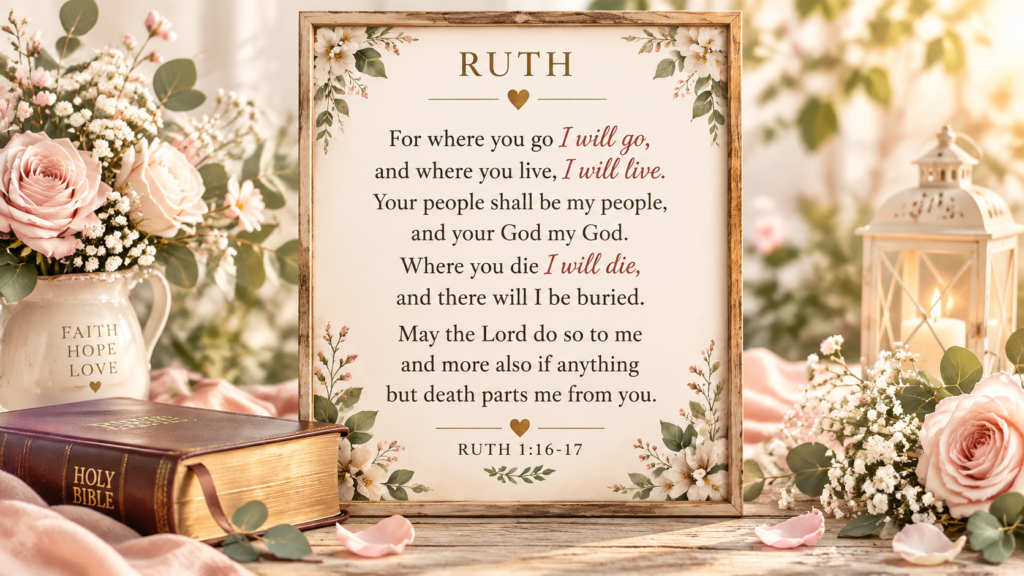
“But Ruth replied, ‘Don’t urge me to leave you or to turn back from you. Where you go I will go, and where you stay I will stay. Your people will be my people and your God my God. Where you die I will die, and there I will be buried. May the LORD deal with me, be it ever so severely, if even death separates you and me.'” (Ruth 1:16–17, NIV)
Ruth 1:16-17 is quoted at weddings, read at funerals, and memorized by people who need words for the kind of love that does not calculate cost before it commits. But this passage carries far more theological and emotional depth than most readings of it explore. These 7 powerful lessons from Ruth 1:16-17 will show you what Ruth was actually saying, why she said it, and what it means for every relationship — human and divine — that you hold today.
Ruth 1:16-17 — The Full Context That Makes the Words Make Sense
Before examining the seven lessons, the setting of Ruth 1:16-17 must be understood — because these words were not spoken in a comfortable moment. They were spoken in one of the most desolate circumstances the book of Ruth describes.
Naomi had left Bethlehem with her husband Elimelech and their two sons during a famine. They settled in Moab. Elimelech died. Both sons married Moabite women — Orpah and Ruth. Then both sons died. Naomi was left in a foreign land, widowed, childless, without income or security, surrounded by two young widows who were themselves without futures in their society.
When Naomi heard that the famine in Bethlehem had ended, she decided to return home. She urged both daughters-in-law to go back to their own families — where they might remarry, where they had social standing, where they had a future. Orpah kissed Naomi goodbye and left. Ruth refused.
Ruth 1:16-17 is what Ruth said after Naomi urged her a second time to leave. It is not a casual sentiment. It is a costly, deliberate, permanent commitment — made to a woman who had nothing to offer and no way to repay it, spoken in full knowledge of what staying would cost.
7 Powerful Lessons From Ruth 1:16-17
Lesson 1 — Real Love Makes Its Decision Before It Counts the Cost
The first and most foundational lesson from Ruth 1:16-17 is that Ruth did not negotiate. She did not ask what she would receive in return. She did not calculate the odds of her situation improving if she stayed with Naomi rather than returning to her family in Moab.
Naomi had explicitly told Ruth that she could offer nothing. She said to both daughters-in-law: “I am too old to have another husband. Even if I thought there was still hope for me — even if I had a husband tonight and then gave birth to sons — would you wait until they grew up? Would you remain unmarried for them?” (Ruth 1:12–13). Naomi made the poverty of the offer clear. Ruth said yes anyway.
Ruth 1:16-17 establishes a model of love that does not depend on favorable terms. The “where you go I will go” was spoken after the terms had been made explicitly unfavorable. This is what makes it one of the most theologically significant expressions of covenant love in all of Scripture — it was unconditional in the fullest sense of that word.
Lesson 2 — Loyalty Is a Choice, Not a Feeling
The second lesson from Ruth 1:16-17 is that what Ruth demonstrated was not an emotion — it was a decision. Orpah wept when she left. Ruth wept too (Ruth 1:14). The feelings of grief and attachment were the same for both women. What differed was the choice each made in the middle of those feelings.
This matters enormously for how we understand the kind of love Ruth 1:16-17 describes. It was not the love that stays because everything feels warm and easy. It was the love that stays because a commitment has been made — because the person in front of you matters more than the comfort available elsewhere.
The Hebrew concept of hesed — covenant love, loyal love, steadfast love — is what Ruth demonstrated in Ruth 1:16-17. The same word is used throughout the book of Ruth and throughout the Psalms to describe God’s love for His people. Hesed is not romantic feeling. It is committed, deliberate, persistent faithfulness regardless of what it costs the person practicing it.
Lesson 3 — “Where You Go I Will Go” Means Leaving Everything Behind
The third lesson from Ruth 1:16-17 is the scale of what Ruth was agreeing to. “Where you go I will go” was not a poetic sentiment. It was a description of what would actually happen.
Ruth was leaving Moab — her home country, her family, her culture, her language, her gods, her social network, and every form of security she had known. She was following an elderly widow to a foreign land where she would be a Moabitess — a nationality that carried significant stigma in Israel (Deuteronomy 23:3 excluded Moabites from the assembly of the Lord). She was choosing a future as an outsider, a foreigner, a person without social standing, in a culture she had not grown up in.
Ruth 1:16-17 is one of the most striking examples of voluntary vulnerability in the entire Old Testament. Ruth chose a position of maximum disadvantage — foreign, widowed, poor, without social connections — because the person she was committed to was going there.
Lesson 4 — “Your God Will Be My God” Is the Most Important Line
The fourth lesson from Ruth 1:16-17 is the one most often overlooked in sentimental readings of the passage — but it is theologically the most significant line in the entire declaration.
“Your people will be my people and your God my God.” Ruth was not only choosing a relationship with Naomi. She was choosing the God of Israel. She was renouncing the gods of Moab — Chemosh and others — and declaring her allegiance to the LORD, the God she had encountered through Naomi’s family.
This is a conversion declaration embedded in Ruth 1:16-17. It is why Ruth is one of the most remarkable figures in the Old Testament — a Gentile woman who chose the God of Israel through loyalty to an Israelite woman, and who through that choice entered the lineage of David and ultimately the lineage of Jesus Christ (Matthew 1:5).
The “your God my God” of Ruth 1:16-17 is not an add-on to the loyalty declaration. It is its theological foundation. Ruth was not simply choosing to follow a beloved mother-in-law. She was choosing to follow the God she had come to know through that relationship — and committing to that God in the same permanent, unconditional way she committed to Naomi.
Lesson 5 — The Vow Included Death
The fifth lesson from Ruth 1:16-17 is the most striking and most overlooked detail of the passage: Ruth did not promise to stay until things improved, or until Naomi was settled, or until a better option presented itself. She promised to stay until death — and beyond it.
“Where you die I will die, and there I will be buried.” Ruth committed to Naomi not just for the journey back to Bethlehem but for the entirety of life. Death was the only thing that would separate them — and even in death, Ruth wanted to be buried beside her.
In ancient Near Eastern culture, burial location was profoundly significant. To be buried in a foreign land, away from your own people and your ancestors, was a form of permanent exile. Ruth was voluntarily accepting that exile — choosing to make Bethlehem not just her home for life but her resting place forever.
Ruth 1:16-17 closes with an oath invoking God’s judgment: “May the LORD deal with me, be it ever so severely, if even death separates you and me.” This is the strongest possible commitment formula in the Hebrew Bible — calling down divine punishment on yourself if you break your word. Ruth was not speaking casually. She was making a covenant.
Lesson 6 — This Is a Mirror of God’s Love for His People
The sixth lesson from Ruth 1:16-17 is that Ruth’s love for Naomi is a deliberate theological mirror of the hesed — covenant love — that God consistently demonstrates toward His people throughout Scripture.
Naomi had nothing to offer God. She was bitter, grieving, and returning from a season in which she felt God had abandoned her (Ruth 1:20–21). Yet God did not abandon her. Through Ruth’s loyalty, God was already at work providing for Naomi in ways she could not yet see.
The same pattern runs through the entire Bible. God chooses the unlikely, the outsider, the one with nothing to offer, and demonstrates covenant faithfulness that does not depend on their performance or their circumstances. Ruth 1:16-17 is the human-scale version of the same love that Psalm 136 describes — the hesed that endures forever.
Boaz later recognized this when he said to Ruth: “The LORD bless you, my daughter. This kindness is greater than that which you showed earlier” (Ruth 2:20). The word translated “kindness” is hesed — the same word used for God’s own covenant love. Boaz saw in Ruth’s loyalty to Naomi the reflection of God’s character.
Lesson 7 — Ruth 1:16-17 Reshapes What “Family” Means
The seventh lesson from Ruth 1:16-17 is the one that makes it so appropriate at weddings, at adoptions, at any moment when a relationship is being chosen rather than inherited.
Ruth was not Naomi’s biological daughter. She had no genetic obligation to stay. No legal requirement. No social pressure — in fact, the social pressure was entirely in the other direction, urging her to go home. Ruth chose Naomi. And in choosing her, she became family in a way that transcended biology.
This is why Ruth 1:16-17 is quoted in contexts far beyond its original setting. It captures something universal about the moment when love becomes covenant — when a relationship moves from circumstantial to chosen, from convenient to committed, from dependent on favorable conditions to permanent regardless of conditions.
The New Testament reflects this same expansion of family. Jesus said: “Here are my mother and my brothers! For whoever does the will of my Father in heaven is my brother and sister and mother” (Matthew 12:49–50). The family of God is a chosen family — people who have said to God what Ruth said to Naomi: where You go I will go, Your people will be my people, Your God will be my God.
Ruth 1:16-17 — The Full Verse Across Translations
Ruth 1:16-17 has been translated across many Bible versions, each capturing a slightly different dimension of the original Hebrew. Here are the most significant translations.
- NIV: “Where you go I will go, and where you stay I will stay. Your people will be my people and your God my God. Where you die I will die, and there I will be buried.”
- KJV: “Whither thou goest, I will go; and where thou lodgest, I will lodge: thy people shall be my people, and thy God my God. Where thou diest, will I die, and there will I be buried.”
- ESV: “For where you go I will go, and where you lodge I will lodge. Your people shall be my people, and your God my God. Where you die I will die, and there will I be buried.”
- NKJV: “Wherever you go, I will go; and wherever you lodge, I will lodge. Your people shall be my people, and your God, my God. Where you die, I will die, and there will I be buried.”
- NLT: “Wherever you go, I will go; wherever you live, I will live. Your people will be my people, and your God will be my God. Wherever you die, I will die, and there I will be buried.”
When to Use Ruth 1:16-17 and Related Scriptures
Ruth 1:16-17 is one of the most versatile passages in Scripture — appropriate for a wide range of significant life moments.
At weddings: Ruth 1:16-17 is the most commonly quoted Old Testament passage at Christian and non-religious weddings alike. Its language of permanent, unconditional commitment — choosing someone regardless of what the future holds — makes it the most complete expression of marriage vows outside the wedding service itself.
At adoptions and family ceremonies: The chosen-family dimension of Ruth 1:16-17 makes it perfect for ceremonies celebrating non-biological family bonds — adoptions, blended families, or any moment when people choose each other as family regardless of genetics.
For friendship: Proverbs 17:17 says “a friend loves at all times, and a brother is born for a time of adversity.” Ruth 1:16-17 is the lived-out version of this proverb — a friendship that held in the worst possible circumstances and became the foundation of one of the most beautiful redemption stories in the entire Bible.
For conversion and faith commitment: The “your God will be my God” dimension of Ruth 1:16-17 makes it appropriate for any moment when someone is declaring their commitment to the God of the Bible — particularly for those coming to faith from other backgrounds or traditions.
For comfort in grief: Naomi was grieving when Ruth made this declaration. The passage speaks directly into the experience of loss — offering the reminder that chosen love does not abandon in the darkest moments.
Frequently Asked Questions About Ruth 1:16-17
What is the meaning of Ruth 1:16-17?
Ruth 1:16-17 is Ruth’s declaration of permanent loyalty to her mother-in-law Naomi after both women were widowed in Moab. Ruth refused Naomi’s urging to return to her family and instead committed to follow Naomi back to Bethlehem, adopting Naomi’s people and God as her own. The passage expresses unconditional covenant love (Hebrew hesed) — love that is not dependent on favorable circumstances, reciprocal benefit, or social obligation. It is one of the most complete expressions of committed loyalty in all of Scripture.
Why is Ruth 1:16-17 used at weddings?
Ruth 1:16-17 is used at weddings because its language perfectly captures the nature of marriage vows — permanent, unconditional commitment that follows the other person regardless of what the future holds. “Where you go I will go” and “where you die I will die” express a totality of commitment that covers every possible circumstance. While the original context is a daughter-in-law speaking to a mother-in-law, the language transcends that relationship and applies to any bond defined by chosen, covenantal love.
What does “your God will be my God” mean in Ruth 1:16-17?
This phrase is the most theologically significant line in Ruth 1:16-17. Ruth was a Moabite — from a nation with its own gods. By saying “your God will be my God,” Ruth was renouncing the gods of Moab and declaring her allegiance to the LORD, the God of Israel. This is a conversion declaration — the moment Ruth formally adopted the faith of Israel. It explains why Ruth is included in the genealogy of Jesus Christ in Matthew 1:5, as a Gentile woman who chose the God of Israel through her loyalty to an Israelite woman.
What is hesed and how does it relate to Ruth 1:16-17?
Hesed is the Hebrew word for covenant love — loyal, steadfast, committed faithfulness that does not depend on favorable circumstances or reciprocal treatment. It is the word used most frequently in the Psalms for God’s love toward His people. Ruth 1:16-17 is widely considered one of the most complete human demonstrations of hesed in the entire Old Testament. Boaz later used the word hesed to describe Ruth’s loyalty to Naomi (Ruth 2:20 and 3:10), recognizing in her behavior the same quality of love that characterizes God’s relationship with His people.
Why did Orpah leave and Ruth stay?
Both Orpah and Ruth loved Naomi — Ruth 1:14 says both of them wept. Orpah’s choice to return to Moab was not presented as wrong or disloyal in the text. Naomi had explicitly urged both of them to go, and Orpah followed that advice. Ruth’s choice to stay was exceptional — an act of extraordinary hesed that went beyond what was expected or required. The contrast between Orpah and Ruth in Ruth 1:16-17 illustrates the difference between love that is reasonable and love that is sacrificial.
What is the historical and cultural context of Ruth 1:16-17?
Ruth 1:16-17 takes place during the period of the Judges — a time of instability in Israel. Naomi’s family had fled famine, and Ruth was from Moab, a nation with a complicated relationship with Israel (Deuteronomy 23:3 excluded Moabites from the assembly of the LORD). Ruth’s commitment in Ruth 1:16-17 was therefore particularly costly — she was choosing to become a foreigner with stigmatized nationality in a society where her status would be precarious. The story’s outcome, where Ruth marries Boaz and enters the lineage of David and Jesus, reflects God’s consistent pattern of including the outsider in His redemptive purposes.
What is the oath Ruth makes in Ruth 1:17?
The oath formula “May the LORD deal with me, be it ever so severely, if even death separates you and me” is one of the strongest commitment formulas in the Hebrew Bible. It appears elsewhere in 1 Samuel and 2 Samuel as a way of invoking divine punishment on oneself if the stated commitment is broken. By including this formula in Ruth 1:16-17, Ruth was not simply expressing sentiment — she was making a legally and spiritually binding covenant, calling God Himself as witness and judge of her commitment.
How does Ruth 1:16-17 connect to the life of Jesus?
Ruth 1:16-17 connects to Jesus in two ways. First, Ruth is directly named in the genealogy of Jesus in Matthew 1:5 — her loyalty to Naomi, her marriage to Boaz, and her son Obed (who became the grandfather of David) placed her directly in the lineage through which the Messiah came. Second, the quality of love Ruth demonstrated in Ruth 1:16-17 — hesed, unconditional covenant faithfulness — is the same quality of love that Jesus demonstrated at the cross: choosing permanent, costly commitment to people who had nothing to offer in return.
Bible Verses Related to Ruth 1:16-17
- Ruth 2:12 (NIV) — “May the LORD repay you for what you have done. May you be richly rewarded by the LORD, the God of Israel, under whose wings you have come to take refuge.” Boaz acknowledging Ruth’s choice of the God of Israel.
- Proverbs 17:17 (NIV) — “A friend loves at all times, and a brother is born for a time of adversity.” The principle behind Ruth’s loyalty.
- 1 Corinthians 13:7 (NIV) — “It always protects, always trusts, always hopes, always perseveres.” The New Testament description of the same love Ruth practiced.
- John 15:13 (NIV) — “Greater love has no one than this: to lay down one’s life for one’s friends.” Ruth’s willingness to give up her future in Moab mirrors this standard.
- Romans 8:38–39 (NIV) — “Neither death nor life… will be able to separate us from the love of God.” The divine hesed that Ruth’s human hesed reflects.
- Matthew 1:5 (NIV) — “Salmon the father of Boaz, whose mother was Rahab, Boaz the father of Obed, whose mother was Ruth.” Ruth’s place in the lineage of Jesus Christ.
Final Thought: Ruth 1:16-17 Is Still Being Spoken
Every time someone chooses to stay when they had every reason to leave — every time love goes toward a person in their worst season rather than away from them — something of Ruth 1:16-17 is being lived out. The words were spoken once, in a field in Moab, by a young widow who had no guarantee of anything except the person she was walking beside.
That is what makes Ruth 1:16-17 so enduring. Not that it is poetic — though it is. Not that it is ancient — though it is. But that it describes something every human being recognizes when they see it: the love that does not calculate, does not negotiate, and does not leave when circumstances make leaving the reasonable choice.
It is also a picture of something larger. The God who inspired this story is the same God who says to every person who comes to Him: where you go I will be with you, your people are my people, and nothing — not even death — will separate you from me. Ruth 1:16-17 is human love at its most beautiful. It is also a small window into divine love at its most consistent.
To read the complete book of Ruth — one of the most beautifully structured stories in all of Scripture — visit Ruth 1 on Bible Gateway and let the full story show you how Ruth 1:16-17 became the beginning of something far larger than either Ruth or Naomi could have imagined.
LOOKING FOR SOME MORE ENGAGING CONTENT:
Touch Not My Anointed: 7 Powerful Truths That Reveal What This Scripture Really Means