They That Wait Upon the Lord: 7 Powerful Truths From Isaiah 40:31 That Will Change How You Wait
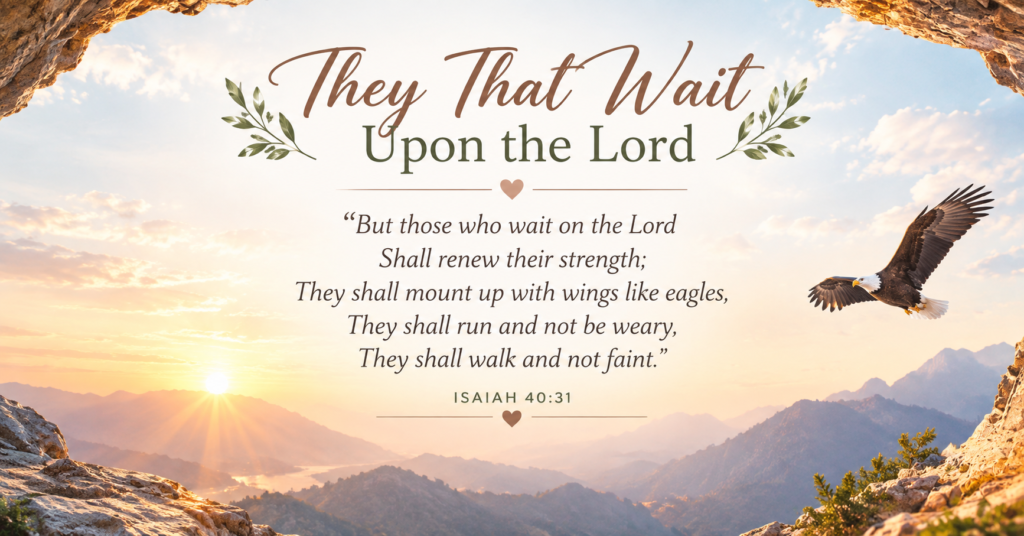
“They that wait upon the Lord shall renew their strength; they shall mount up with wings as eagles; they shall run, and not be weary; and they shall walk, and not faint.” Isaiah 40:31 (KJV) is one of the most quoted verses in the entire Bible — read at funerals, memorized in hospitals, declared over hard seasons, and printed on more greeting cards than almost any other passage in Scripture.
And yet they that wait upon the Lord is one of the most misunderstood phrases in the Bible. Most people read it as a promise of recovery — that if you hold on long enough, God will eventually swoop in and restore your energy. But the original Hebrew text is saying something far more radical than that. Something that changes not only how you understand waiting, but how you actually do it.
These 7 powerful truths from Isaiah 40:31 will show you what “they that wait upon the Lord” actually means, why it is the most active spiritual posture in the Bible, and why the promise attached to it is available to you in every season — not just the dramatic ones.
They That Wait Upon the Lord — The Full Verse and Its Context
Before examining the seven truths, the full verse and its context must be understood — because Isaiah 40:31 is not a standalone inspirational quote. It is the climax of one of the most sustained and powerful theological arguments in the entire Old Testament.
Isaiah 40 opens with the word “Comfort” — repeated twice for emphasis: “Comfort, comfort my people, says your God.” The people receiving this word were exhausted. They were facing the aftermath of national sin, the threat of Assyrian invasion, decades of spiritual fatigue, and the accumulated weight of circumstances that had drained them of hope and strength.
Isaiah’s response to their exhaustion was not to simply tell them to try harder or trust more. He spent the entire chapter establishing who God is before he made any promise. He described God sitting above the circle of the earth, spreading out the heavens like a curtain, naming and counting every star, sovereign over every nation. And then — only after this extended declaration of who God is — Isaiah arrived at verse 31: “But they that wait upon the Lord shall renew their strength.”
The “but” is everything. It is a contrast to verse 30 — “Even the youths shall faint and be weary, and the young men shall utterly fall.” Isaiah is saying: the naturally strong will eventually hit the wall of their own limitations. Everyone does. But they that wait upon the Lord — they are different. Not because they are stronger. Because their source is different.
7 Powerful Truths About They That Wait Upon the Lord
Truth 1 — “Wait” Does Not Mean Passive
The most important thing to understand about “they that wait upon the Lord” is what the Hebrew word for wait actually means — because it is not what most people assume.
The Hebrew word translated “wait” in Isaiah 40:31 is qavah. Its root meaning is not to sit quietly and do nothing. Qavah means to bind together, to twist into a cord, to intertwine. It is related to the Hebrew word tikvah — which means hope — and which literally describes a cord or thread stretched out under tension.
They that wait upon the Lord are not people who have stopped moving while they wait for God to do something. They are people who have actively bound themselves to God — who have directed their entire hope and expectation toward Him, who keep turning back to Him rather than filling the silence with other sources of strength.
This kind of waiting involves prayer. It involves the sustained practice of trust. It involves refusing to rush toward what feels more immediate or more certain than God’s promises. It is possibly the most demanding spiritual posture the Bible describes — precisely because it requires sustained, active orientation toward an unseen God in the middle of very visible circumstances.
Truth 2 — “Renew” Means Exchange, Not Refuel
The second truth about they that wait upon the Lord is equally surprising. The Hebrew word translated “renew” is chalaph — and it does not primarily mean to refresh or restore what was there before.
Chalaph means to change, to exchange, to put off one thing and put on another. It is the word used for changing clothes — one thing removed, something entirely different put in its place.
They that wait upon the Lord do not simply receive more of the strength they already had. They exchange their depleted human strength for something qualitatively different — God’s own energy and capacity working through them.
This is not refueling an empty tank with the same fuel. It is removing the empty tank and installing a completely different power source. The person who genuinely practices “they that wait upon the Lord” does not return to their original human capacity refreshed. They operate from divine capacity — strength that originates in God rather than in themselves.
Truth 3 — The Three Images Are in Deliberate Order
The three images in Isaiah 40:31 — mounting up with wings as eagles, running and not being weary, walking and not fainting — are not random. They appear in descending order of intensity, and the order carries significant theological weight.
Mounting up with wings as eagles describes the high moments — the experiences of prayer, worship, and spiritual breakthrough where God’s presence is felt acutely and the soul seems to rise above ordinary limitations effortlessly. Eagles do not flap continuously to soar. They find the rising thermal currents and spread their wings, allowing the invisible upward force to carry them. This is the image of being carried by God’s power.
Running and not being weary describes the sustained middle pace — the daily discipline of faithful obedience, consistent prayer, regular service, the showing up that does not produce burnout because the supply is coming from outside the person rather than from their own reserves.
Walking and not fainting describes the most ordinary and — many commentators argue — the most significant level: simply continuing on without collapsing in the unremarkable moments of daily life. The Tuesday when nothing special is happening. The ordinary day when the prayer has not yet been answered, the diagnosis is the same, and life still has to continue.
Isaiah listed walking last and the most dramatically impressive image first — which suggests that they that wait upon the Lord may be most tested not in the soaring moments but in the walking ones.
Truth 4 — The Promise Is for All Three Seasons
One of the most comforting truths about they that wait upon the Lord is that the promise covers all three images equally. God’s strength is available not only when the eagle experience arrives — but also when it does not.
Many believers want the soaring experience and feel spiritually deficient when most of their life looks like walking. But Isaiah did not list only the eagle. He listed all three because they that wait upon the Lord receive God’s strength in all three expressions — the spectacular, the steady, and the ordinary.
Not fainting while simply walking through an ordinary day is just as much an expression of divine strength as mounting up with wings. In some ways it is more remarkable — because it happens every single day, in every ordinary moment, sustained by a strength that does not originate in the person doing the walking.
Truth 5 — Waiting Is Not the Same as Being Passive About Prayer
They that wait upon the Lord are not people who have stopped praying, stopped asking, or stopped bringing their needs before God. Waiting in the biblical sense runs alongside consistent prayer — not instead of it.
Psalm 27:14 says: “Wait for the LORD; be strong and take heart and wait for the LORD.” The command to wait is paired with “be strong” — an active posture. Psalm 40:1 says: “I waited patiently for the LORD; he turned to me and heard my cry.” The waiting and the crying out happened simultaneously.
They that wait upon the Lord are simultaneously praying, trusting, choosing God as their source in every moment, and refusing to resolve the tension by running toward alternatives. The waiting is not a suspension of prayer — it is prayer’s most sustained expression.
Truth 6 — Waiting Requires Refusing Substitute Sources of Strength
One of the most practical dimensions of they that wait upon the Lord is what it requires you to refuse. Waiting on God — in the qavah sense — means choosing not to fill the silence with other sources that feel more immediate, more certain, or more within your control.
Israel’s temptation throughout the Old Testament was not usually outright atheism. It was turning to Egypt, to political alliances, to idols — anything that could provide strength and security faster than the God who sometimes seemed slow. Isaiah 30:15 captures the same tension: “In repentance and rest is your salvation, in quietness and trust is your strength, but you would have none of it.”
They that wait upon the Lord choose, repeatedly and actively, to remain bound to God as their source rather than trading that orientation for something that feels more immediately satisfying. This is why qavah — binding yourself to God — is the right word. It describes the deliberate refusal to unbind yourself from Him even when the waiting is long.
Truth 7 — The Context Is Exhaustion, Not Comfort
The final and perhaps most important truth about they that wait upon the Lord is who Isaiah was writing it for. This promise was not given to people who were doing well and needed encouragement to keep going. It was given to people who were at the end of their rope.
Isaiah 40:29–30 says: “He gives strength to the weary and increases the power of the weak. Even youths grow tired and weary, and young men stumble and fall.” The verse immediately before the promise establishes that even the people who should have reserves left — the young, the naturally strong — will eventually run out.
They that wait upon the Lord is a promise for people who are already exhausted. Not people who have managed their energy well and are looking for a spiritual boost. People who have nothing left. People who have already hit the wall of every human capacity they possessed and found it insufficient.
If that is where you are right now — the promise in Isaiah 40:31 was written for you specifically. Not for people who have already recovered. For people who have not yet, and who need a strength that does not come from within themselves to keep going.
Related Bible Verses About They That Wait Upon the Lord
Isaiah 40:31 does not stand alone in Scripture. These passages form the complete biblical framework for understanding what it means to wait upon the Lord and what that waiting produces.
- Isaiah 40:31 (KJV) — “They that wait upon the LORD shall renew their strength; they shall mount up with wings as eagles; they shall run, and not be weary; and they shall walk, and not faint.” The foundational passage.
- Psalm 27:14 (NIV) — “Wait for the LORD; be strong and take heart and wait for the LORD.” The active, courageous dimension of waiting.
- Psalm 40:1 (NIV) — “I waited patiently for the LORD; he turned to me and heard my cry.” Testimony that waiting and crying out happen together.
- Lamentations 3:25 (NIV) — “The LORD is good to those whose hope is in him, to the one who seeks him.” Waiting and seeking are connected.
- Psalm 62:5 (NIV) — “Yes, my soul, find rest in God; my hope comes from him.” The soul directed to God — the essence of qavah.
- Psalm 130:5–6 (NIV) — “I wait for the LORD, my whole being waits, and in his word I put my hope. I wait for the Lord more than watchmen wait for the morning.” The whole-being orientation of biblical waiting.
- Romans 8:25 (NIV) — “But if we hope for what we do not yet have, we wait for it patiently.” New Testament confirmation that waiting is the posture of genuine hope.
- Galatians 6:9 (NIV) — “Let us not become weary in doing good, for at the proper time we will reap a harvest if we do not give up.” The promise that they that wait upon the Lord will eventually see the result of their waiting.
What They That Wait Upon the Lord Looks Like in Practice
Understanding the Hebrew of Isaiah 40:31 is one thing. Living it out in the middle of a difficult season is another. Here is what they that wait upon the Lord looks like as a daily practice rather than a theological concept.
It looks like bringing your emptiness to God rather than hiding it. The exchange chalaph describes — trading your strength for His — requires bringing what you actually have, not what you wish you had. They that wait upon the Lord come to Him depleted, honest about it, and open to receiving what only He can give.
It looks like praying when you do not feel like it. Qavah — binding yourself to God — is maintained through consistent prayer even when the prayer feels hollow. The discipline of returning to God in prayer is itself the practice of waiting on Him, regardless of how it feels in the moment.
It looks like refusing to resolve the tension prematurely. They that wait upon the Lord choose not to fill the silence with substitutes — not to chase the faster answer, not to trust the more visible source, not to take the situation back into their own hands before God has had the opportunity to act. This requires saying no to what feels more immediately certain than a promise that has not yet arrived.
It looks like choosing to walk when you cannot soar. On the days when the eagle experience is nowhere to be found, they that wait upon the Lord still show up — still pray, still trust, still take the next step. Not because they feel spiritually capable of it, but because the promise covers the walking season just as completely as the soaring one.
A Prayer for They That Wait Upon the Lord
Father, I have been running on my own strength longer than I should have. I have been trying to find reserves that were never there, and I have kept trying to recover what can only be exchanged.
Teach me what they that wait upon the Lord actually means — not passive resignation, but the active binding of myself to You as my source. Let my whole being wait for You the way Psalm 130 describes — more than watchmen wait for the morning.
Take what I have left. It is not much. Exchange it for what only You can provide — not a top-off of my own depleted supply, but Your own strength working through my emptiness.
When You give me moments of soaring, let me receive them with gratitude. When most of life looks like running, give me the sustained capacity that does not burn out. And when all I can manage is walking — let me not faint. Because they that wait upon the Lord have Your promise for that too. In Jesus’ name, Amen.
Frequently Asked Questions About They That Wait Upon the Lord
What does “they that wait upon the Lord” mean?
The phrase comes from Isaiah 40:31 (KJV). The Hebrew word for “wait” is qavah, which means to bind together, intertwine, or hold in expectant tension — not passive endurance. They that wait upon the Lord are people who have actively and continuously oriented themselves toward God as their source of strength, bound their hope to Him, and refused to fill the silence with substitutes. It is the most active spiritual posture the Bible describes.
What is the full verse of “they that wait upon the Lord”?
Isaiah 40:31 (KJV) reads in full: “But they that wait upon the LORD shall renew their strength; they shall mount up with wings as eagles; they shall run, and not be weary; and they shall walk, and not faint.” The NIV renders it: “But those who hope in the LORD will renew their strength. They will soar on wings like eagles; they will run and not grow weary, they will walk and not be faint.”
What does “renew their strength” mean in they that wait upon the Lord?
The Hebrew word for renew is chalaph, meaning to exchange or replace — not simply to restore. They that wait upon the Lord do not receive more of their own depleted strength. They exchange it for God’s strength — a qualitatively different supply that originates in Him rather than in themselves. This is not refueling. It is a transfer of the power source entirely.
Why does Isaiah 40:31 list eagles, running, and walking in that order?
The images descend from most dramatic to most ordinary: soaring (spectacular spiritual experiences), running (sustained faithful effort), and walking (ordinary daily persistence). Many commentators note that the most ordinary image — walking without fainting — is placed last and may be the most significant promise for most people in most seasons. They that wait upon the Lord receive God’s strength at all three levels, not only in the mountaintop moments.
Is “they that wait upon the Lord” a promise for everyone?
The verse specifies a condition: “they that wait upon the Lord.” The promise belongs to those who actively practice qavah — binding themselves to God in expectant, sustained trust rather than turning to alternative sources of strength. It is not a universal guarantee but a covenant promise attached to a specific spiritual posture. The good news is that this posture is available to anyone who chooses it.
What is the context of Isaiah 40:31?
Isaiah 40 opens with “Comfort, comfort my people” — addressed to people who were exhausted by national trauma, spiritual fatigue, and circumstances that had drained their hope. The chapter spends twenty-nine verses establishing the majesty and sovereignty of God before arriving at verse 31. The promise of they that wait upon the Lord is preceded by the declaration that even the young and naturally strong will eventually run out of strength — setting up verse 31 as the specific answer for people at the end of their own resources.
How do you practically wait upon the Lord?
Practically, they that wait upon the Lord: bring their emptiness to God rather than hiding it; maintain consistent prayer even when it feels hollow; refuse to fill the silence with faster or more certain substitutes for God’s answer; choose to take the next faithful step when soaring is not the current experience; and return repeatedly to God as their source rather than running on whatever human reserves remain. The waiting is not passive but actively maintained through prayer, trust, and the refusal to unbind yourself from God when the answer has not yet arrived.
What other Bible verses talk about waiting on the Lord?
Psalm 27:14 pairs waiting with strength: “Wait for the LORD; be strong and take heart.” Psalm 40:1 describes waiting alongside crying out. Psalm 130:5–6 describes waiting with the whole being. Lamentations 3:25 connects waiting with goodness for those whose hope is in God. Romans 8:25 confirms that hoping for what is not yet seen means waiting patiently. Together these passages show that they that wait upon the Lord is a sustained biblical theme covering the Old and New Testaments equally.
Final Thought: The Promise Is for People Who Have Nothing Left
Isaiah 40:31 was not written for people who are doing well and need a motivational boost. It was written for people who have already hit the wall of every capacity they possessed and found it insufficient. That is who the promise belongs to. That is who “they that wait upon the Lord” describes.
If you are at the end of yourself right now — the promise is yours. Not the promise that you will immediately soar. Perhaps the more important promise: that you will walk, and not faint. That the strength you need for the most ordinary step of the most ordinary day is available from a source that does not deplete. That they that wait upon the Lord receive an exchange — not a refill of what they had, but something qualitatively different working through their emptiness.
Bring what you have. Bind yourself to Him. And discover what they that wait upon the Lord have always discovered: the exchange is more than sufficient for everything the day requires.
To read Isaiah 40 in its full context — the complete chapter that builds to the promise of verse 31 — visit Isaiah 40 on Bible Gateway and let the entire chapter show you who the God of this promise actually is.
LOOKING FOR SOME MORE ENGAGING CONTENT:
Love One Another as I Have Loved You: 7 Powerful Truths That Change Every Relationship