Uncircumcised Meaning: 7 Powerful & Helpful Facts
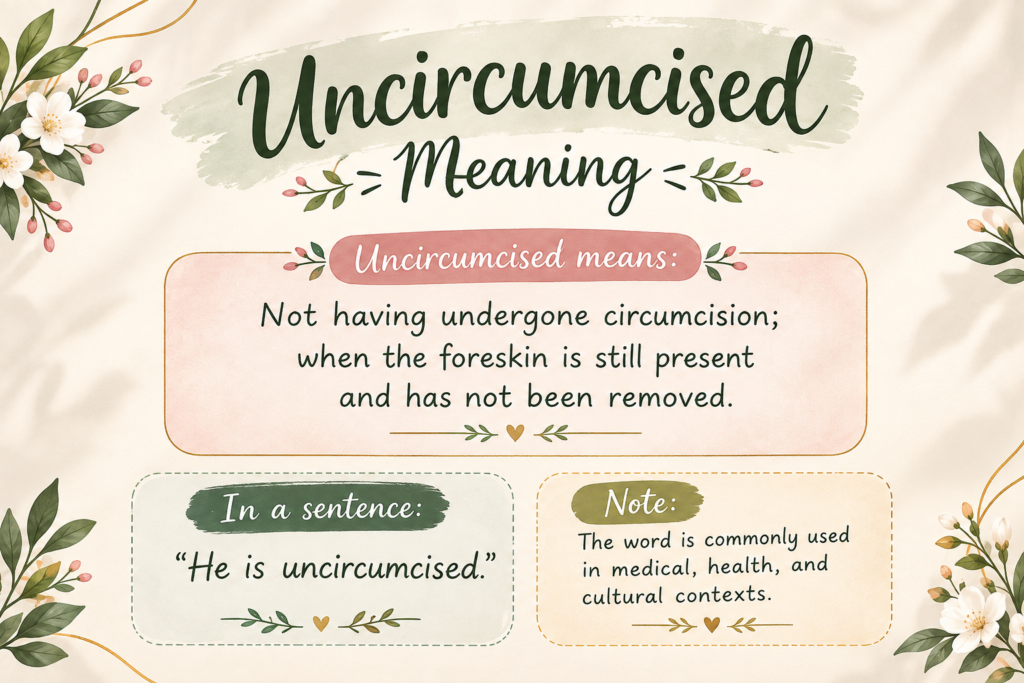
The word uncircumcised can mean something very simple medically, yet it carries a much deeper meaning in the Bible. In everyday language, it generally describes a male who has not had the foreskin removed through circumcision. In Scripture, however, the word can refer not only to physical status but also to spiritual resistance, covenant identity, and the condition of the heart.
Understanding the uncircumcised meaning therefore requires looking at both contexts.
In the Old Testament, circumcision was established as a sign of God’s covenant with Abraham and his descendants in Genesis 17. Later biblical writers used “uncircumcised” figuratively when speaking about hearts, ears, and even lips.
From a health perspective, being uncircumcised is not itself a disease or medical diagnosis. An uncircumcised person simply has a foreskin. Good hygiene is important, while persistent pain, inflammation, difficulty urinating, or a foreskin that becomes stuck may require medical attention.
Here are seven important facts that bring the biblical and health meanings together.
1. Uncircumcised Meaning: The Basic Definition
The simplest uncircumcised meaning is “not circumcised.”
Circumcision is a procedure in which the foreskin covering the head of the penis is removed. Therefore, an uncircumcised male retains his foreskin. This is the ordinary physical meaning of the word.
The term should not automatically be understood as meaning that someone is unhealthy, unclean, immoral, or spiritually separated from God. Those conclusions depend on the context in which the word is being used.
This distinction is especially important when reading the Bible because Scripture sometimes uses physical language symbolically.
2. Why Circumcision Was Important in the Bible
The biblical story of circumcision begins prominently with Abraham in Genesis 17.
God gave circumcision as a sign of the covenant between Himself, Abraham, and Abraham’s descendants. It became an important marker of belonging within Israel’s covenant community.
Because of this covenant background, “uncircumcised” could sometimes identify people outside Israel’s covenant community. Philistines, for example, are repeatedly described this way in the Old Testament.
David’s famous confrontation with Goliath provides one recognizable example. David refers to Goliath as an uncircumcised Philistine in 1 Samuel 17:26.
The word therefore carried social, religious, and covenant significance in its ancient setting—not merely a medical meaning.
3. The Bible Also Uses “Uncircumcised” Spiritually
One of the most important discoveries when studying this topic is that Scripture does not restrict circumcision language to the body.
The Bible speaks about:
- an uncircumcised heart
- uncircumcised ears
- uncircumcised lips
These expressions describe something happening inside a person.
For example, Moses speaks about an uncircumcised heart in the context of stubbornness and turning back toward God. Jeremiah uses the image of uncircumcised ears for people who hear God’s message but refuse to receive it. The Bible also records Moses describing his own lips as uncircumcised when expressing his inadequacy in speaking to Pharaoh.
So the spiritual meaning is not about a physical body part.
It is about being resistant, unresponsive, or unwilling to listen and obey God.
4. What Does an “Uncircumcised Heart” Mean?
The phrase uncircumcised heart is one of the clearest examples of biblical symbolism.
Deuteronomy 10:16 calls God’s people to “circumcise” their hearts and stop being stubborn. The point is not physical surgery. It is a call for inner surrender and genuine responsiveness to God.
Jeremiah later makes the same point in a sharper way: physical circumcision alone does not prove spiritual faithfulness. A person can carry an outward religious sign while still resisting God inwardly.
This gives the phrase a powerful lesson:
God is concerned not only with outward religious identity but also with the condition of the heart.
That idea becomes especially important in the New Testament.
5. What Changes in the New Testament?
The New Testament develops the idea of circumcision beyond physical identity.
Paul teaches in Romans 2 that outward circumcision does not automatically make someone righteous. He emphasizes the importance of an inward work of the heart.
Likewise, Galatians 5:6 teaches that in Christ, physical circumcision or uncircumcision is not what ultimately counts; faith expressing itself through love is what matters.
Paul also explains that Gentile believers who were once described as physically uncircumcised were brought near to God through Christ. Ephesians 2 presents this as part of the reconciliation between Jews and Gentiles.
This does not mean the Old Testament covenant sign was meaningless.
Rather, the New Testament shifts attention toward the deeper spiritual reality: faith, transformation, and belonging to Christ.
For Christians, physical circumcision is therefore not presented as the requirement that determines salvation.
6. Is Being Uncircumcised Unhealthy?
From a medical perspective, being uncircumcised is not automatically a health problem.
The foreskin is a normal anatomical structure. People who are not circumcised can maintain good genital hygiene with appropriate care. Mayo Clinic notes that boys who are not circumcised can be taught regular cleaning beneath the foreskin as they grow, while also emphasizing that a baby’s foreskin should not be forcibly pulled back.
Circumcision may offer some health benefits, including lower risks of certain infections and some penile conditions, but Mayo Clinic also notes that the risks associated with remaining uncircumcised are generally low and can be reduced with proper care.
Possible foreskin-related medical problems can include:
- balanitis, or inflammation of the penis head
- recurrent infections
- phimosis, where the foreskin is unusually tight
- pain during erections
- difficulty urinating
- problems retracting or returning the foreskin
These conditions are different from simply being uncircumcised.
If there is persistent pain, swelling, discharge, bleeding, difficulty urinating, or a foreskin that becomes stuck behind the penis head, medical evaluation is appropriate. A retracted foreskin that cannot return to its normal position can be an emergency because blood flow may be restricted.
7. How Should an Uncircumcised Penis Be Cared For?
Good hygiene is generally straightforward.
For adults and older boys whose foreskin retracts comfortably, gently pulling it back during washing allows the area underneath to be cleaned. The foreskin should then be returned to its normal position afterward. The NHS recommends regular washing and avoiding strongly perfumed products that may irritate the skin.
For babies, care is different.
A baby’s foreskin usually does not fully retract, and it should not be forcibly pulled back. Mayo Clinic recommends gently washing the outside with warm water and allowing natural separation to occur over time.
A simple rule is:
Clean gently, never force the foreskin, and seek medical advice when symptoms persist.
For more detailed medical information, the NHS circumcision guide explains when circumcision may be considered medically and what problems can lead doctors to recommend it.
Uncircumcised vs. Circumcised: What’s the Difference?
| Feature | Uncircumcised | Circumcised |
|---|---|---|
| Foreskin | Present | Removed |
| Basic definition | No circumcision performed | Circumcision performed |
| Hygiene | Requires regular cleaning | No foreskin to clean beneath |
| Biblical context | Could represent Gentile status or spiritual imagery | Covenant sign in ancient Israel |
| Medical status | Not automatically a disease | Not automatically healthier in every respect |
| Possible foreskin problems | Phimosis or balanitis can occur | Foreskin-specific problems cannot occur |
| Spiritual status in Christianity | Does not determine salvation | Does not determine salvation |
The key is to avoid confusing physical status with spiritual worth.
What Does Uncircumcised Mean Spiritually?
Spiritually, biblical references to uncircumcision can describe a person who is resistant to God.
An “uncircumcised heart” points toward stubbornness, disobedience, or an unwillingness to respond to God’s truth. An “uncircumcised ear” similarly describes someone who refuses to truly listen.
The deeper biblical message is therefore about inner transformation.
A person can perform outward religious practices while still keeping the heart closed. Scripture repeatedly calls God’s people toward something deeper: a heart that listens, trusts, loves, and obeys.
Does Being Uncircumcised Affect Your Relationship With God?
For Christians, physical circumcision is not presented as the basis of salvation.
Paul’s teaching emphasizes faith rather than physical status. Romans 4 is particularly important because Abraham’s faith and righteousness are discussed in relation to circumcision, showing that his faith was not dependent upon the physical sign itself. Bible Gateway’s biblical encyclopedia likewise summarizes the New Testament distinction between outward circumcision and inward spiritual transformation.
So someone should not conclude that being physically uncircumcised automatically means being spiritually distant from God.
The biblical emphasis ultimately moves toward faith, grace, obedience, and a transformed heart.
Common Misunderstandings About Being Uncircumcised
Uncircumcised does not mean dirty
Proper hygiene matters, but having a foreskin is not inherently unhygienic. Regular, appropriate cleaning can maintain good genital health.
Uncircumcised does not automatically mean unhealthy
Some medical risks can be higher without circumcision, but that does not mean every uncircumcised person has a health problem.
Uncircumcised does not automatically mean spiritually separated from God
The New Testament places the emphasis on faith and inner transformation rather than physical circumcision.
Biblical “uncircumcised heart” does not describe anatomy
It is a spiritual metaphor for stubbornness or resistance to God.
FAQs About Uncircumcised Meaning
What does uncircumcised mean?
Uncircumcised means that the foreskin has not been removed through circumcision. In biblical contexts, the word can also have covenantal and symbolic meanings.
What does uncircumcised mean in the Bible?
In the Bible, it can literally describe someone who has not been circumcised. Depending on context, it can also refer to Gentiles outside Israel’s covenant community or symbolically describe spiritual resistance to God.
What is the spiritual meaning of uncircumcised?
Spiritually, “uncircumcised” can describe a heart, ear, or person that is resistant or unresponsive to God.
What does an uncircumcised heart mean?
An uncircumcised heart refers to inner stubbornness or resistance toward God. Deuteronomy uses the image as a call to stop resisting God and become responsive to Him.
Why was circumcision important in the Bible?
Circumcision was established as a sign of God’s covenant with Abraham and his descendants in Genesis 17. It became an important marker of Israel’s covenant identity.
Are Christians required to be circumcised?
Christian teaching in the New Testament does not make physical circumcision a requirement for salvation. Paul repeatedly emphasizes faith and life in Christ rather than physical status.
Is being uncircumcised unhealthy?
Not necessarily. An uncircumcised person can maintain good health with proper hygiene. Some conditions, including balanitis and phimosis, may occur and should be medically assessed when symptoms are persistent or severe.
How should an uncircumcised penis be cleaned?
For someone whose foreskin retracts normally, gently retract it, wash underneath with water, dry gently, and return the foreskin to its normal position. A baby’s foreskin should not be forcibly retracted.
Can an uncircumcised person have a normal sex life?
Yes. Being uncircumcised does not by itself prevent normal sexual function. If pain, tightness, recurrent inflammation, or other symptoms occur, a healthcare professional can assess the cause.
When should someone see a doctor about the foreskin?
Medical advice is appropriate for persistent pain, swelling, recurrent infections, bleeding, discharge, difficulty urinating, painful erections, or significant problems retracting the foreskin. A foreskin that is pulled back and cannot return to its normal position requires urgent medical attention.
Final Thoughts
The meaning of uncircumcised changes depending on the context.
Physically, it simply describes a male who has a foreskin. Biblically, it can describe someone outside the ancient covenant community, but Scripture also uses the word symbolically for hearts and ears that resist God.
The most important biblical lesson is not about judging someone’s physical condition. It is about what happens inside a person.
The Bible repeatedly points beyond outward signs toward a heart that is willing to listen, trust, love, and follow God.
From a health perspective, being uncircumcised is not automatically a problem. Gentle hygiene and appropriate medical care are usually the key considerations. When symptoms such as persistent inflammation, pain, or difficulty urinating occur, professional medical advice is the right next step.
In short: the physical meaning concerns the foreskin; the biblical spiritual meaning points toward the heart.
LOOKING FOR SOME MORE ENGAING CONTENT: